Daka & Associates | Independence Day Perspective | 24 October 2026
As Zambia marks 62 years of independence, the approach of Vision 2030, the transition from the Eighth to the Ninth National Development Plan and the emergence of the Grow Zambia Agenda invite a practical question: how do national ambitions become investable projects, productive infrastructure, capable enterprises and better livelihoods?
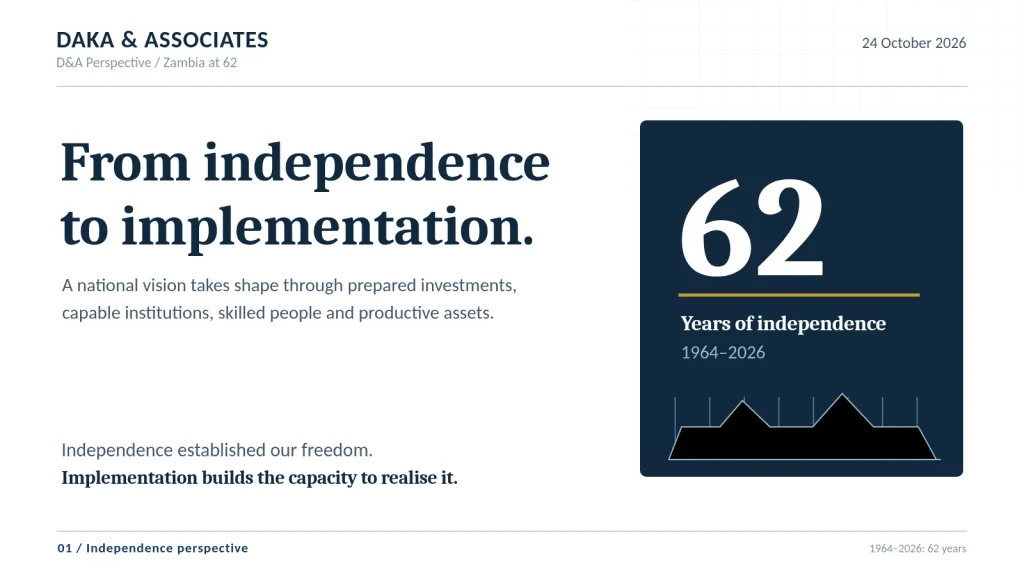
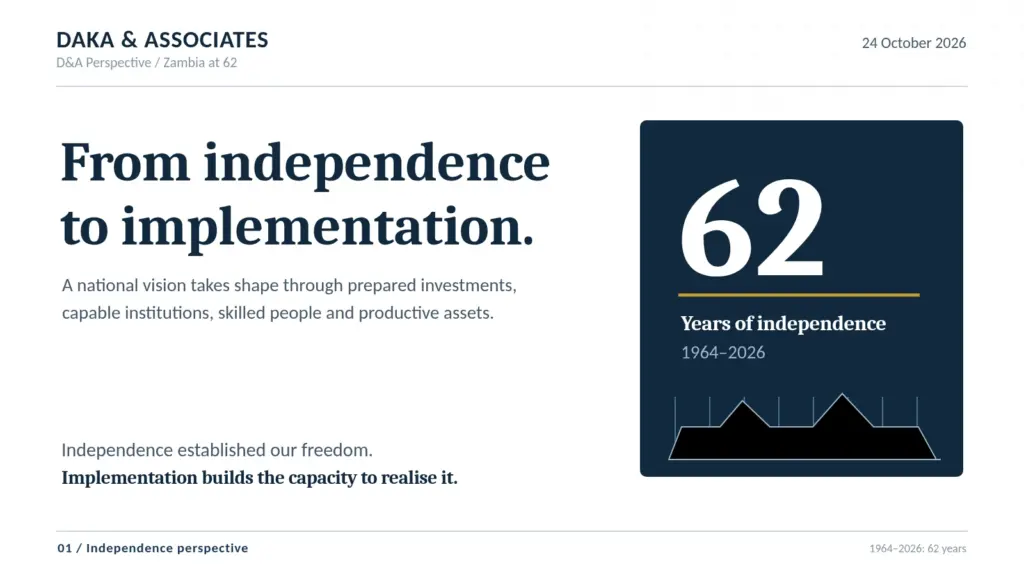
Independence is a foundation. Development is a continuing responsibility.
On 24 October 1964, Zambia attained independence and the right to determine its own political, economic and social future. Sixty-two years later, that achievement remains a foundation of our national identity. It also prompts a continuing question: what does it mean to exercise independence meaningfully in the development of a nation?
Political sovereignty provides the authority to choose a national direction. Economic capability, functioning institutions and human development provide the means to move towards it. The two are related, but they are not the same.
Zambia possesses substantial natural resources, entrepreneurial potential and a growing base of technical and professional talent. The country has also articulated its development aspirations through a long-term national vision and successive planning frameworks. The remaining challenge is to translate those aspirations into economic and social results that are sustained over time.
The work is not limited to building more infrastructure. It involves choosing the right investments, making them viable, preparing them well, organising capable delivery teams, managing public and private resources responsibly and maintaining the resulting assets.
Independence gives a nation the freedom to determine its future. Implementation builds the capacity to realise it.
A defining intersection of national development plans
Zambia’s 62nd Independence Anniversary falls at an important point in the country’s planning cycle.
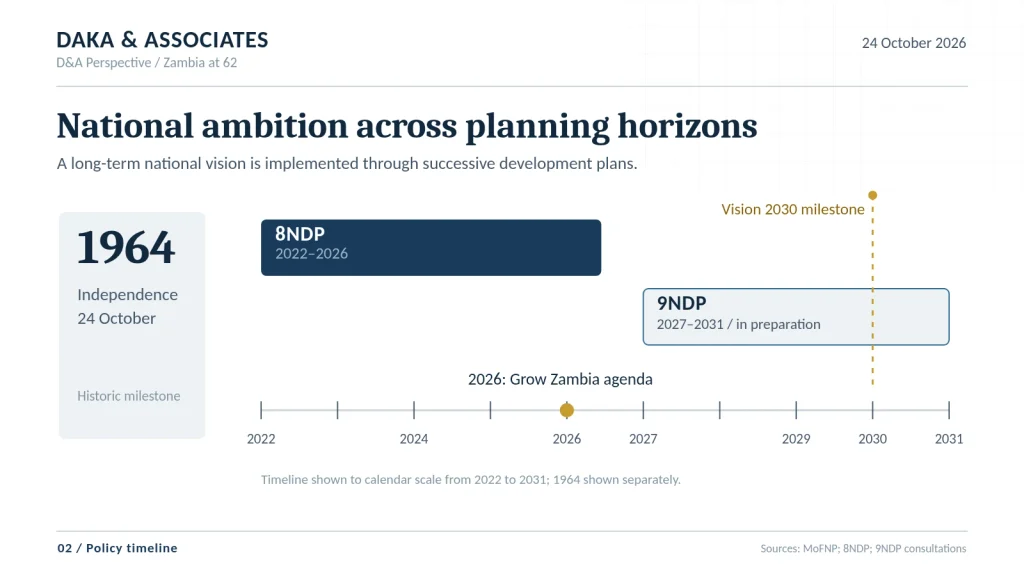
Vision 2030 expresses the national aspiration to become a prosperous middle-income country. It envisages an industrialised, competitive and resilient economy that creates opportunities for improving people’s wellbeing. The Eighth National Development Plan (8NDP), covering 2022 to 2026, provides the present medium-term planning framework. Meanwhile, the Ninth National Development Plan (9NDP), intended to cover 2027 to 2031, has been under preparation during 2026.
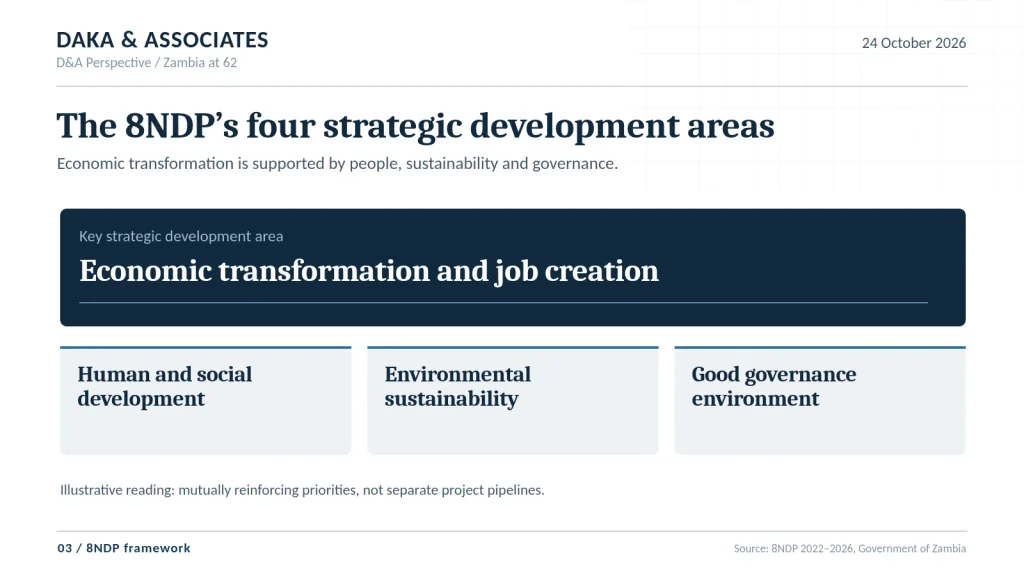
The 8NDP sets out four strategic development areas: economic transformation and job creation; human and social development; environmental sustainability; and a good governance environment. The central development proposition is that economic transformation depends on productive sectors, supportive institutions, human capability and the infrastructure that connects them.
The emerging 9NDP matters because its planning period will extend beyond the Vision 2030 milestone. It can provide continuity between immediate investment decisions and longer-term outcomes, while incorporating lessons from the preceding plan. Its final content and approved commitments should not be assumed before the planning process is complete.
A national plan provides direction; it does not itself provide a project design, a bankable business case, a competent contractor or a functioning maintenance budget. Those are the practical connections that must be created in implementation.
Growth ambitions create infrastructure and delivery obligations
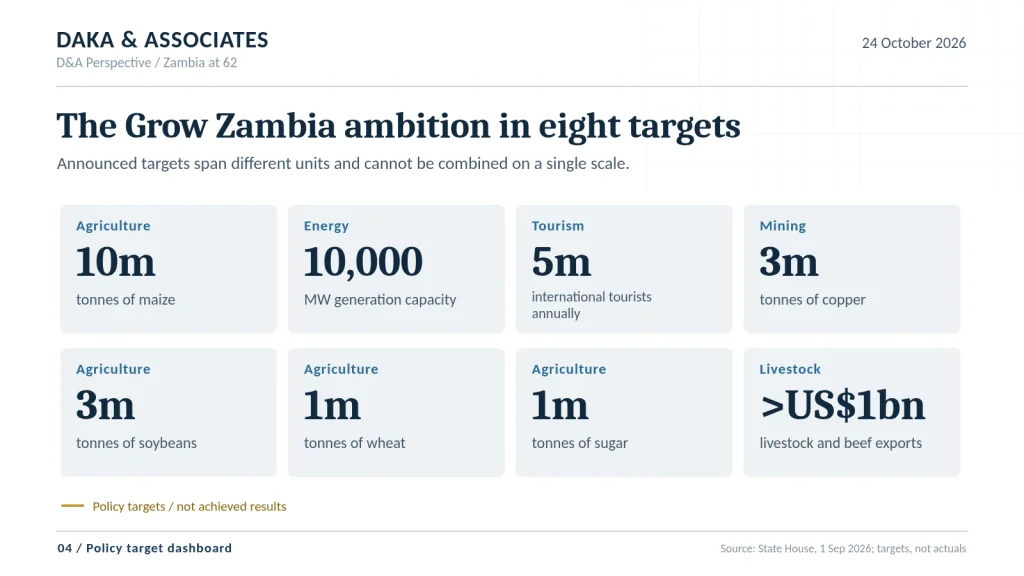
The Grow Zambia Agenda, announced in 2026, adds a more explicit emphasis on economic production, investment, employment and opportunity. Public statements describing the agenda refer to eight production and sector targets commonly expressed as 10-10-5-3-3-1-1-1. They encompass ambitions for maize, electricity generation, tourism, copper, soybeans, wheat, sugar, and livestock or beef exports.
These are announced policy targets, not measured achievements. Their importance for the construction and infrastructure industry is the scale of the enabling systems that the targets would require.
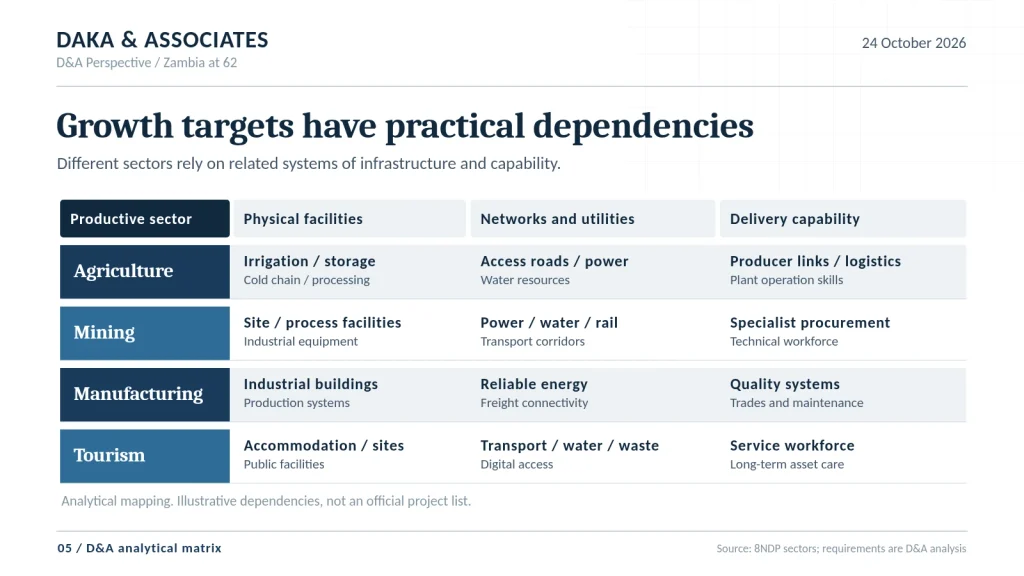
Consider energy. Expanding electricity-generation capacity requires more than power plants. It also depends on transmission and distribution networks, substations, land and permitting arrangements, grid integration, technical expertise and financing arrangements capable of supporting construction and operations.
Agricultural expansion similarly depends on irrigation, storage, processing, rural transport, reliable power, water management and access to markets. Higher copper production can require improvements in energy supply, mineral-processing infrastructure, transport corridors, water systems and specialised industrial services. Tourism requires dependable access, accommodation, water and sanitation, reliable utilities, environmental management and a service-ready workforce.
These dependencies are not separate from the growth ambition. They determine whether output can expand sustainably and whether the benefits of investment reach other sectors of the economy.
The relevant question is not only how much infrastructure Zambia builds, but whether each investment enables productive activity and delivers value over its useful life.
That distinction matters because the existence of a growth target does not establish that every proposed project is viable. Proposed investments still require evidence of demand, clear scope, realistic cost, regulatory compliance and appropriate commercial and financial structuring.
Project readiness: the bridge between intention and investment
A development opportunity can be important and commercially promising without being ready for financing or construction. In practice, many of the most consequential project decisions are made before the first contractor arrives on site.
Project sponsors must define the problem and intended users, establish land and development rights, investigate feasibility, develop technical and financial assumptions, assess environmental and social requirements, identify approvals, and determine how the asset will be procured, operated and maintained.
These requirements become more complex where several parties must coordinate. A development may involve landowners, public authorities, financiers, architects, engineers, quantity surveyors, legal advisers, contractors, suppliers and eventual operators. Without clarity of roles and decisions, an attractive concept can become an expensive uncertainty.
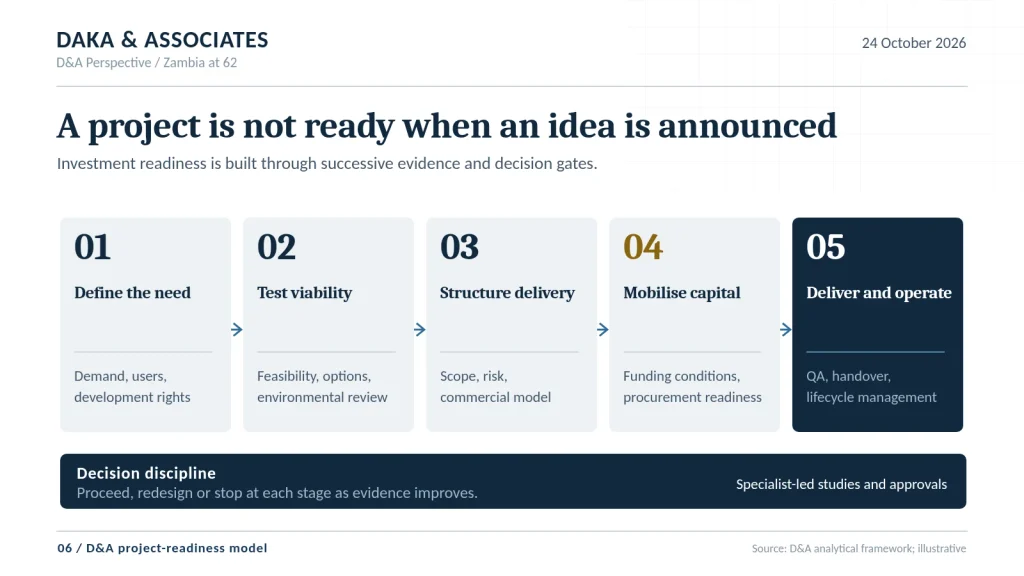
Poor preparation often appears later as variations, procurement delays, unresolved interfaces, disputes, financing gaps or assets that do not achieve their intended performance. Early project development does not eliminate these risks, but it can make them visible while there is still an opportunity to respond at reasonable cost.
For investors and public institutions alike, a credible pipeline should distinguish ideas from feasibility-stage proposals, investment-ready projects, procured developments, construction projects and operating assets. Each stage requires different evidence and decisions.
Financing should follow the economics of the asset
Zambia’s development ambitions require capital, but additional finance alone cannot compensate for weak project structures.
The 8NDP recognises the importance of private-sector participation and development finance. Public statements on the Grow Zambia Agenda also describe an intention to use instruments such as public-private partnerships, joint ventures and capital-market finance. The suitability of any structure depends on the project, the parties and the applicable legal and regulatory requirements.
A public health facility, a rural water network, a commercial warehouse and an industrial processing plant do not have the same revenue model or social obligations. Some are essential public services with limited direct cost recovery. Others may produce commercial cash flows that support debt or equity investment. Some may require public funding, grants, concessional arrangements or blended structures.
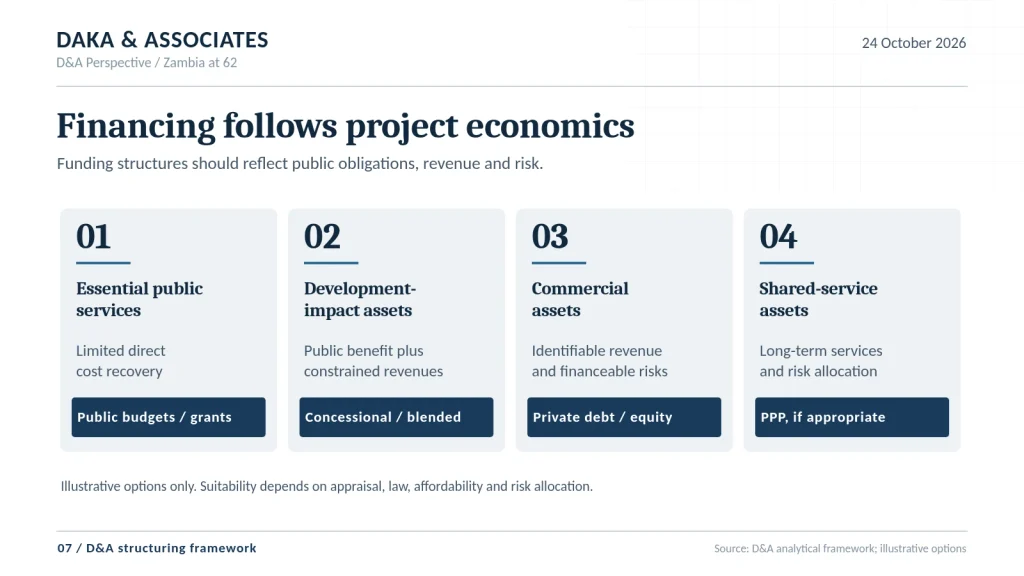
Early commercial analysis should examine who benefits, who pays, what can reasonably be charged, where risks sit and what obligations remain after construction. It should also consider whether financing is affordable and sustainable, not merely whether a transaction can be completed.
The objective is not to make every project commercially financed. It is to choose a responsible capital structure for an investment that can justify its costs and fulfil its intended purpose.
Local enterprise participation is a capability challenge
New infrastructure and productive investment can generate opportunities for Zambian contractors, manufacturers, professional service providers, transport operators and suppliers. Yet proximity to a project does not guarantee that local enterprises can participate effectively.
Smaller firms may have technical ability but lack bid capacity, quality systems, sufficient working capital or an adequate record of similar assignments. Manufacturers may struggle to secure predictable offtake, technical certification or inventory finance. Contractors may face mismatches between payment terms and the cash required to mobilise labour, materials and equipment.
Improving domestic participation requires procurement processes that safeguard transparency and competition while allowing capable enterprises to demonstrate and improve their competence. Contract packaging, supplier development, workforce planning, accessible commercial information, practical partnerships and fair payment arrangements can all contribute.
The lasting outcome should be more than temporary subcontracting during a large project. It should be stronger Zambian businesses able to deliver work repeatedly, safely and competitively.
Skills development must meet real project demand
Infrastructure capability is fundamentally a human-capital question. Buildings, energy installations, transport systems and industrial facilities depend on tradespeople, technicians, engineers, supervisors, project managers, procurement specialists and maintenance personnel.
The link between training and productive work is therefore crucial. Training programmes need a clear understanding of the competencies employers require, the projects likely to create demand, the standards workers must meet and the pathways through which people can gain supervised work experience.
Zambia’s employment structure underscores the scale of this challenge. According to figures from the 2025 Labour Force Survey cited by the Ministry of Labour and Social Security in October 2026, 3.02 million of an estimated 4.76 million employed people, or 63.4%, were in informal employment. This is a measure of the employment structure, not a measure of the construction sector alone.
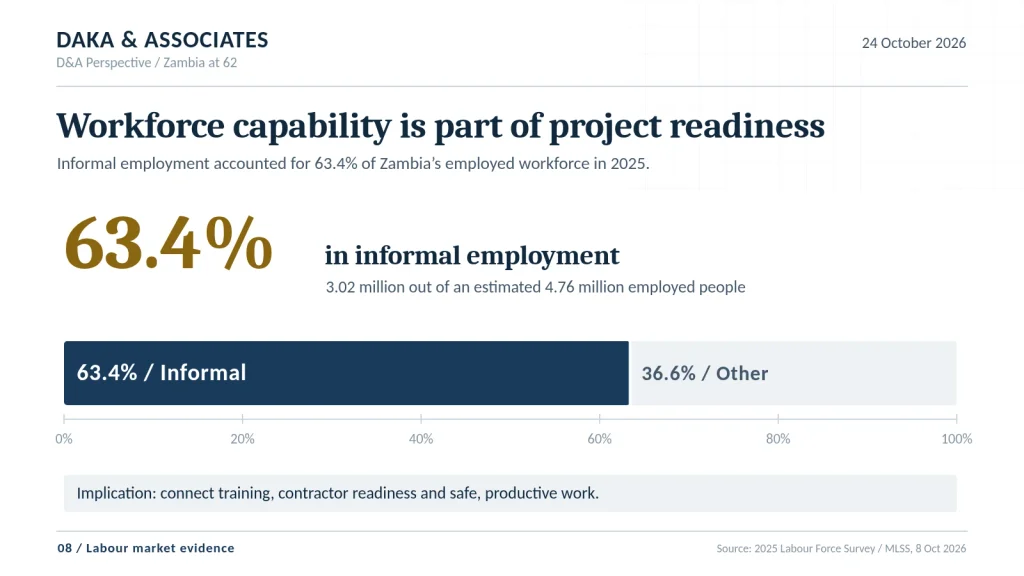
In the construction and infrastructure sectors, greater attention to work readiness, apprenticeships, occupational health and safety, competency assessment, labour standards and progression into stable work can strengthen both project delivery and the employment outcomes associated with investment.
The useful measures of a workforce programme are not only the number of participants trained. They include the competencies acquired, work placements secured, productivity, safe working practices, employment retention and opportunities for progression.
An asset’s value begins before handover and continues after it
Project completion attracts attention because it is visible and relatively easy to record. Long-term development value is harder to measure.
A road must remain serviceable. A health facility must be equipped, staffed and maintained. A water system must deliver reliable service. A processing plant must meet output and quality requirements. A training facility must support learning and work readiness.
This means construction cost and completion date, although important, are not sufficient measures of success. Asset owners and project teams also need to consider operating costs, maintenance, reliability, accessibility, durability, environmental performance and the quality of the service provided.
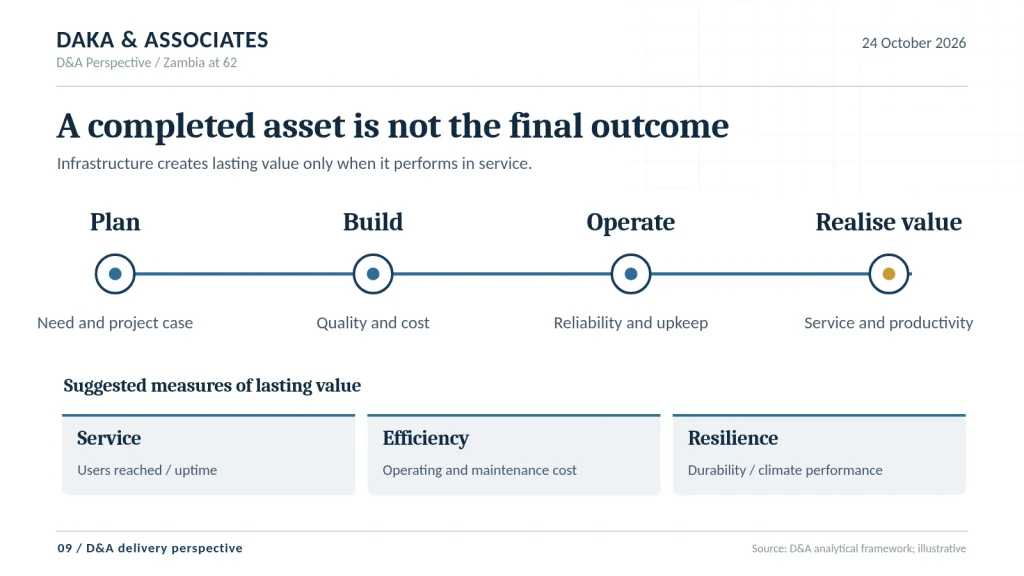
Climate variability and pressure on energy and water systems make such considerations particularly important in Zambia. The lowest initial capital cost does not necessarily represent the best economic value where an asset is unreliable, expensive to maintain or poorly suited to future demand.
Greater attention to lifecycle performance improves the connection between project delivery and public or private benefit.
What should the next planning period make more visible?
The transition from the 8NDP to the proposed 9NDP creates an opportunity to strengthen the practical connection between policy, investment preparation and measurable delivery.
For each priority intervention, institutions and project sponsors should be able to answer a sequence of questions: What development need is being addressed? What evidence supports the proposed solution? What approvals, funding and delivery capabilities are required? What risks remain? Who will operate and maintain the result? What outcome will demonstrate that the intervention has worked?
Good planning should also make the status of a project visible. A concept should not be reported as an investment commitment, a financing announcement should not be confused with financial close, and construction completion should not be treated as proof of long-term performance.
These distinctions support better allocation of scarce capital, more transparent procurement and a clearer understanding of bottlenecks. They are relevant to national government, local authorities, private developers, investors, development partners and the enterprises that execute projects.
The contribution of Daka & Associates
The work of national development is shared. Government establishes public priorities and the relevant institutional and regulatory frameworks. Investors provide capital within appropriate risk structures. Specialist professionals undertake the technical and regulated services needed for competent design and appraisal. Contractors, suppliers and workers make delivery possible. Owners and operators sustain the asset.
Daka & Associates contributes at the points where these functions need to be connected: project development support, procurement and commercial coordination, contractor and specialist-partner identification, workforce planning, and project delivery oversight. Technical design, engineering, legal and regulated financial services remain the responsibility of appropriately registered or authorised specialist providers.
This perspective reflects a practical belief: projects are more likely to progress responsibly when the requirements of finance, technical development, procurement, workforce and operations are considered together rather than in isolation.
We see meaningful national participation not only in the number of contracts won, but in the capabilities that Zambian firms and professionals develop, the value that productive assets generate, and the reliability with which services are delivered.
The Zambia we envision must be built
Sixty-two years of independence deserve commemoration. They also invite a disciplined examination of the capabilities required for the next chapter of Zambia’s development.
Vision 2030 provides a long-term aspiration. The 8NDP has provided a medium-term framework. The preparation of the 9NDP and the emergence of the Grow Zambia Agenda bring further attention to production, employment, investment and delivery.
None of these frameworks can substitute for the practical work of preparing viable projects, structuring appropriate finance, involving capable enterprises, developing skilled people and sustaining the assets that result.
The Zambia we envision is one in which investment creates productive capability, infrastructure improves lives, local businesses compete on merit, skills lead to meaningful work and national resources are used with discipline and purpose.
It must be prepared. It must be financed responsibly. It must be delivered competently. And it must be sustained.
That is the continuing work of nation-building.
Happy 62nd Independence Anniversary, Zambia.
One Zambia. One Nation.
Daka & Associates
Independence Day Perspective | 24 October 2026
Sources and further reading
- Eighth National Development Plan, 2022–2026, Government of Zambia
- Ministry of Finance and National Planning: Update on the 9NDP process, 30 April 2026
- Chibombo Town Council: Public consultation on the 9NDP, 17 July 2026
- Ministry of Labour and Social Security: Grow Zambia Agenda
- State House: Grow Zambia growth and financing agenda, 9 October 2026
- Ministry of Labour and Social Security: 2025 labour-force figures, 8 October 2026
- Ministry of Labour and Social Security: Demand-driven skills under Grow Zambia
Editorial note: This article reflects Daka & Associates’ independent analysis. Policy ambitions are distinguished from achieved outcomes, and illustrative frameworks are not official government policy or project approval requirements.