D&A Construction Industry Insight | 1 October 2026
Zambia’s construction industry enters the final quarter of 2026 with a considerably better macroeconomic backdrop than it faced in early 2025.
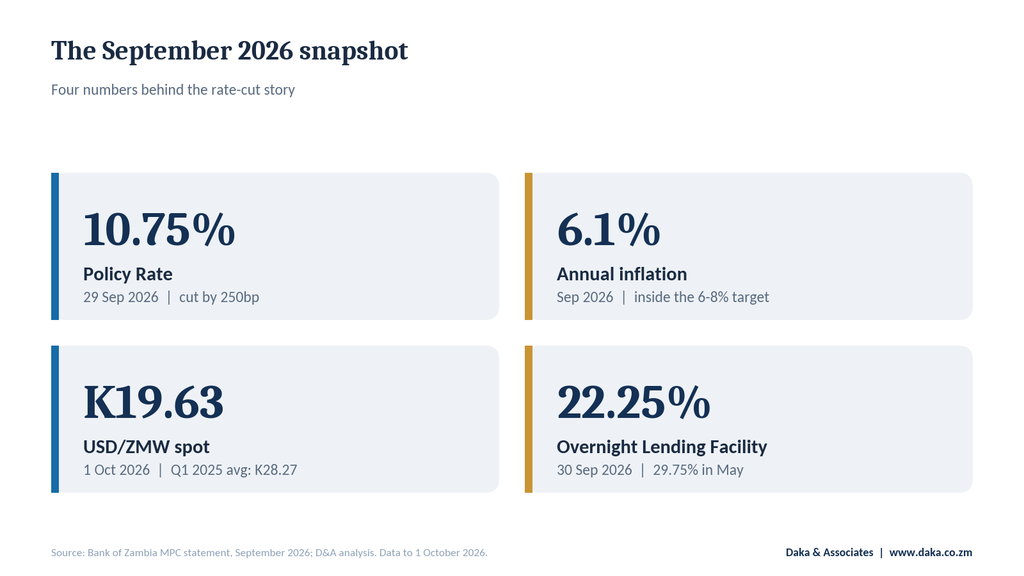
The Bank of Zambia has cut the Policy Rate by 250 basis points to 10.75%. Annual inflation has fallen to 6.1%, inside the Bank’s 6–8% target range. The Kwacha is still far stronger than during the currency pressure of early 2025. For construction, that means less general cost pressure, better economics on many imported goods and the prospect of cheaper finance.
But the improvement is uneven. The Kwacha weakened through the third quarter. Commercial borrowing remains expensive. And access to working capital is a separate problem from the price of finance.
So the practical message for contractors and developers is not simply that rates are down. Project economics should now be rebased to current conditions: current exchange rates, current supplier quotations, actual financing terms and realistic payment cycles.
Our view: the construction cost environment is improving faster than the construction funding environment.
What changed in September?
At its 28–29 September meeting, the Bank of Zambia’s Monetary Policy Committee cut the Policy Rate to 10.75%. Inflation has eased steadily, from 7.1% in March to 6.5% in June and 6.1% in September. The Bank projects average inflation of 6.7% for 2026 and 6.0% for 2027.
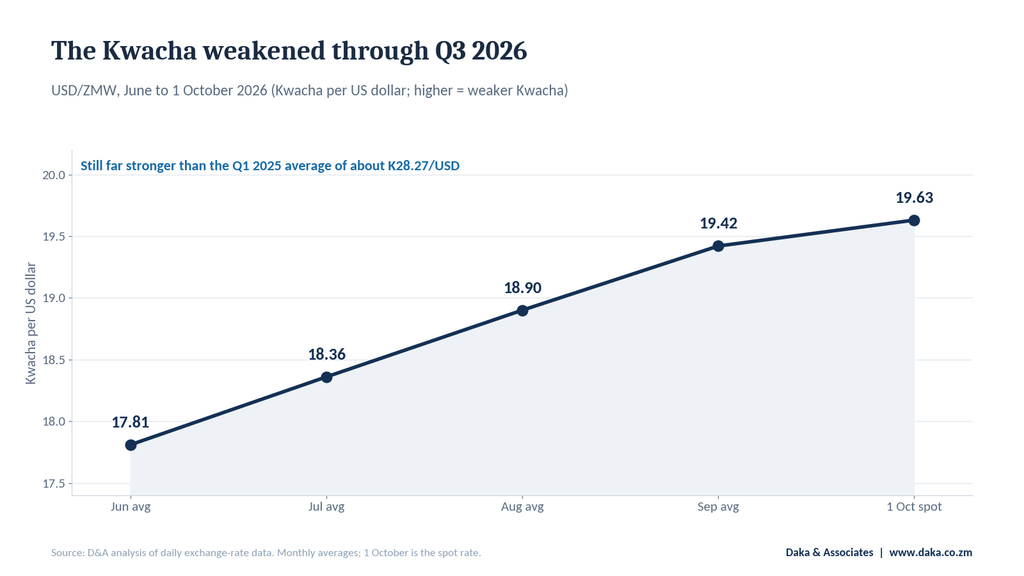
The Kwacha stood at about K19.63/USD on 1 October 2026, against a Q1 2025 average of about K28.27/USD. For businesses importing equipment, specialist materials and construction systems, that is a significant improvement.
The indicators below do not all describe the same date. Inflation, exchange rates and central-bank facility data run to September or 1 October. The latest commercial lending and sector-credit figures available to us are from March 2026.
| Indicator | Reading | As at | Why it matters for construction |
|---|---|---|---|
| Policy Rate | 10.75% | 29 Sep 2026 | Signals easing, but is not a contractor’s borrowing rate |
| Annual inflation | 6.1% | Sep 2026 | Lower general cost pressure |
| USD/ZMW | 19.63 | 1 Oct 2026 | Drives the cost of imported materials and equipment |
| Overnight Lending Facility | 22.25% | 30 Sep 2026 | Shows easing in central-bank liquidity pricing |
| Weighted commercial lending rate | 25.11% | Mar 2026 | Commercial borrowing was still expensive |
| 91-day Treasury bill | 11.45% | Mar 2026 | Reference for short-term domestic financial conditions |
| Construction share of bank lending | 1.30% | Mar 2026 | Credit availability remains a concern (1.53% in Mar 2025) |
| Real-estate share of bank lending | 1.67% | Mar 2026 | Relevant to development finance (2.96% in Mar 2025) |
A September rate cut is not proof that commercial lending rates have already fallen by the same amount.
Two ways the economy reaches a project
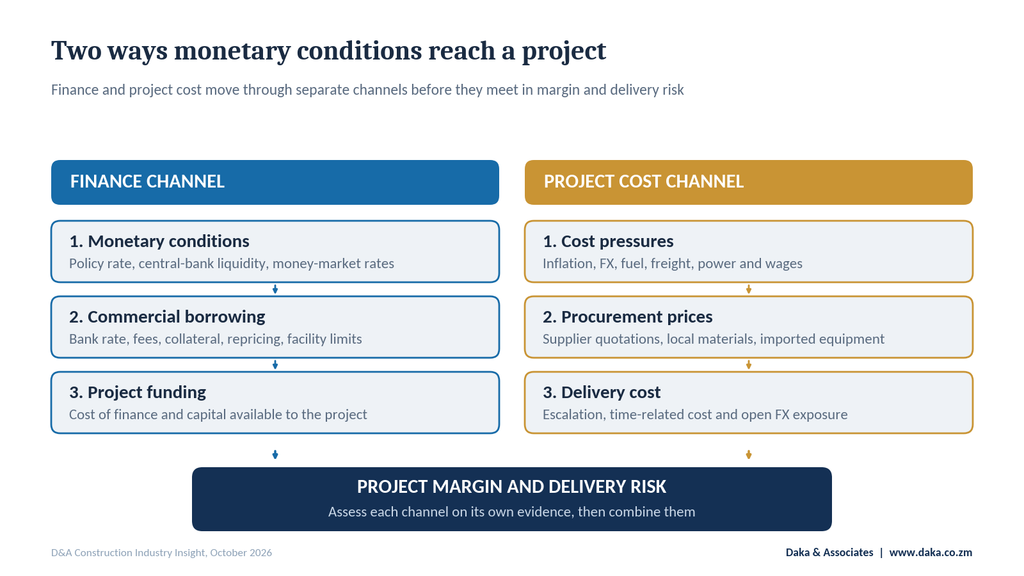
Monetary and macroeconomic conditions reach a construction project through two routes.
The finance channel. Monetary conditions feed into commercial borrowing terms, and from there into working-capital cost and project funding. Lower rates can reduce the cost of carrying overdrafts and project facilities.
The cost channel. Inflation, exchange rates, fuel, freight, electricity and wages feed into supplier pricing, then delivery cost, then project margin.
These channels interact, but they are not the same. A project may become cheaper to finance while imported equipment gets more expensive. Or the Kwacha may strengthen while a contractor still cannot get enough working capital. This is why the Policy Rate alone cannot tell you whether a project has become more profitable or easier to deliver.
The Kwacha and imported construction
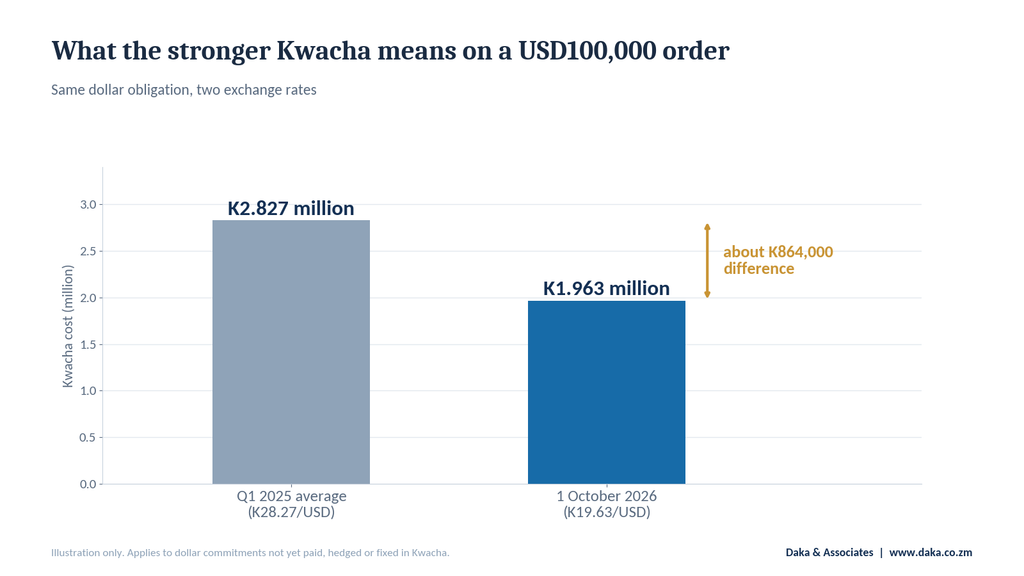
The exchange rate remains one of the biggest variables for import-intensive work. Consider a USD100,000 equipment package:
- At the Q1 2025 average of about K28.27/USD, it cost roughly K2.827 million.
- At about K19.63/USD on 1 October 2026, the same obligation is roughly K1.963 million.
That is a difference of about K864,000.
For projects with imported mechanical and electrical systems, lifts, pumps, process equipment, solar equipment, specialist steel, data-centre systems or construction plant, that can materially change project economics.
The trend within the year matters just as much. The monthly average moved from 17.81 in June to 18.36 in July, 18.90 in August and 19.42 in September. The Kwacha is much stronger than in early 2025, but it has been weakening.
The exposure that matters is the exposure still open
An imported item is not automatically an FX risk. If equipment has already been paid for, hedged or fixed in Kwacha, later exchange-rate moves have little or no effect on that purchase. The risk sits in foreign-currency commitments that are not yet fixed. A contractor holding an unsigned USD quotation that will be paid in two or three months has what commercial teams call open FX exposure. Two contractors buying the same equipment can carry very different risk depending on when and how they procure.
Practical rule: price current imported procurement at the current exchange rate and current supplier quotation, not the best rate achieved earlier in the year.
Lower rates do not mean cheap construction finance
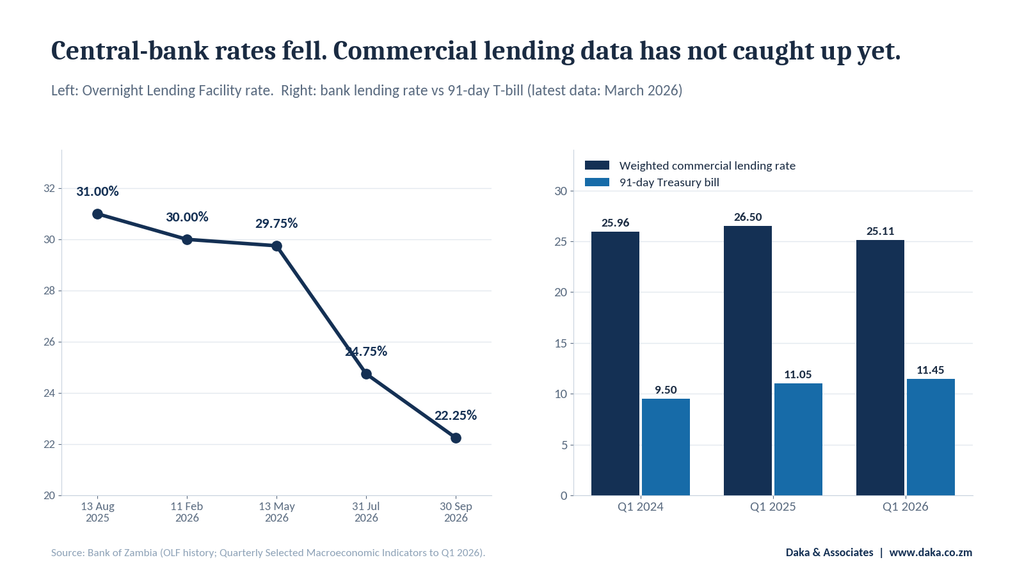
The Policy Rate is not what a contractor pays a commercial bank. The latest weighted commercial lending rate available to us was about 25.11% in March 2026, before the July and September changes.
The Overnight Lending Facility rate fell from 30.00% in February and 29.75% in May to 24.75% in July and 22.25% by 30 September. That points to much easier central-bank liquidity. But it is not a product contractors can borrow from.
Banks still have to price for credit risk, security, collateral, liquidity, facility structure and operating cost. Many existing facilities will reprice only at renewal or a contractual reset date. How much of the easing reaches contractors is still to be seen.
Practical rule: use the rate and fees the lender has actually quoted. Don’t assume a 250-basis-point Policy Rate cut means a 250-basis-point cut in your borrowing cost.
The bigger issue: finance price versus finance availability
There are two separate questions: what does the money cost, and can we get enough of it when the project needs it?
Take a contractor who needs K10 million to fund wages, materials, plant and subcontractors before employer payments arrive. If rates fall, the cost of carrying that K10 million improves. But the contractor still needs K10 million.
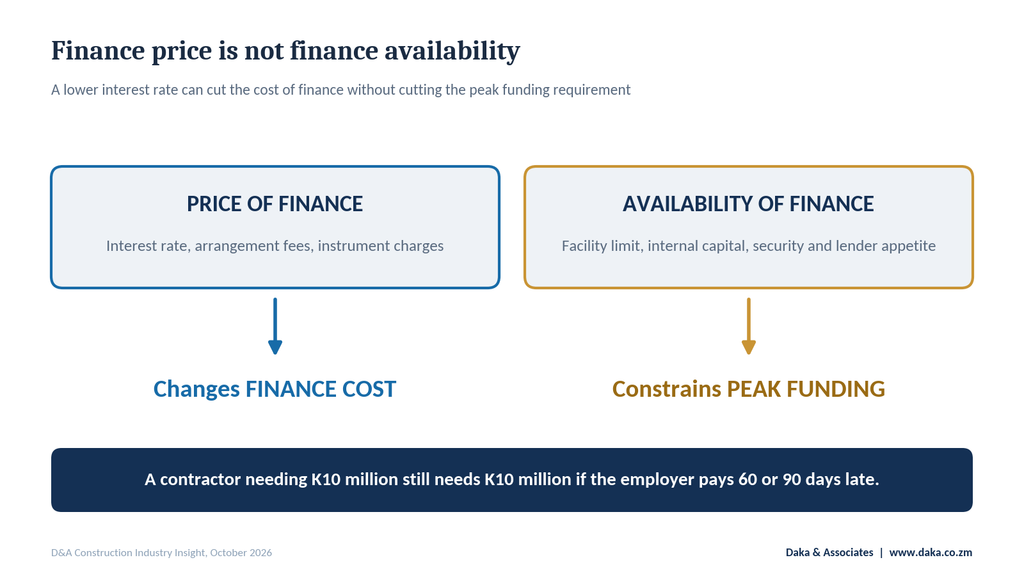
A cheaper facility does not shorten a 60- or 90-day payment cycle. It does not raise an approved overdraft limit. It does not guarantee the contractor can fund an equipment deposit or make payroll while waiting for certification. In construction, cash goes out before it comes in, so a project can be profitable on paper and still fail in execution.
Lower finance cost improves economics. Adequate funding determines whether the project can be delivered.
What lower inflation means for actual construction costs
Inflation at 6.1% is good news. It reduces pressure across the economy and can moderate wage expectations, transport costs and some domestic materials. But CPI is not a construction cost index. A project buys a very different basket from a household: cement, reinforcement steel, aggregates, diesel, haulage, plant, skilled labour, electrical equipment, mechanical systems and specialist fittings.
The right conclusion is that the macroeconomic cost backdrop has improved. It does not mean every material is cheaper. Allowances built during the 2024–25 stress period, such as material rates, escalation percentages and FX premiums, should be checked against current supplier quotations, Zambian market-price information, labour rates and fuel and logistics costs before they roll into new tenders.
Contract terms matter too. A contractor on a fixed-price contract carries far more escalation risk than one with a genuine fluctuation or price-adjustment mechanism.
Who benefits most?
- Import-intensive MEP and specialist systems: the strongest direct benefit from the currency position relative to early 2025, provided procurement hasn’t already been fixed.
- Industrial, energy and process projects: imported plant is a large share of cost, so FX and funding conditions matter most.
- Civil engineering: more exposed to fuel, plant utilisation, programme length and payment cycles, with a more moderate direct FX effect.
- Residential and commercial development: the key question is whether easing reaches development finance and mortgage markets.
- Public infrastructure contracting: slow certification and payment can outweigh the benefit of lower borrowing rates.
- Local manufacturers and suppliers: lower inflation helps, but a stronger Kwacha also makes competing imports cheaper.
Construction credit: watch availability, not only rates
Construction took about 1.30% of bank lending in March 2026, against 1.53% a year earlier. That series is volatile, and the latest reading was above the final quarter of 2025, so it is too early to call a downward trend. Real estate shows a clearer fall, from about 2.96% to 1.67%. These are shares of lending, not absolute credit volumes.
The question to watch is whether easing only makes existing credit cheaper, or also increases the capital available to contractors and developers: larger working-capital facilities, better development finance, better mortgage conditions and more willingness to fund viable projects. That would do more for activity than lower rates alone.
Risks contractors should still price
| Risk | Construction consequence |
|---|---|
| Electricity-generation constraints (El Niño) | Generator costs, lower productivity, longer programmes |
| Higher crude-oil prices | Diesel, plant, freight and haulage costs |
| Renewed global financial tightening | FX pressure and tougher financing |
| Long payment cycles | Higher working-capital need even if rates fall |
| Programme delay | Extra preliminaries, overhead, plant and finance costs |
The aim is not to keep the high-risk assumptions of 2024–25 forever. It is to update the central case while keeping credible downside protection.
Six questions to ask before fixing a price
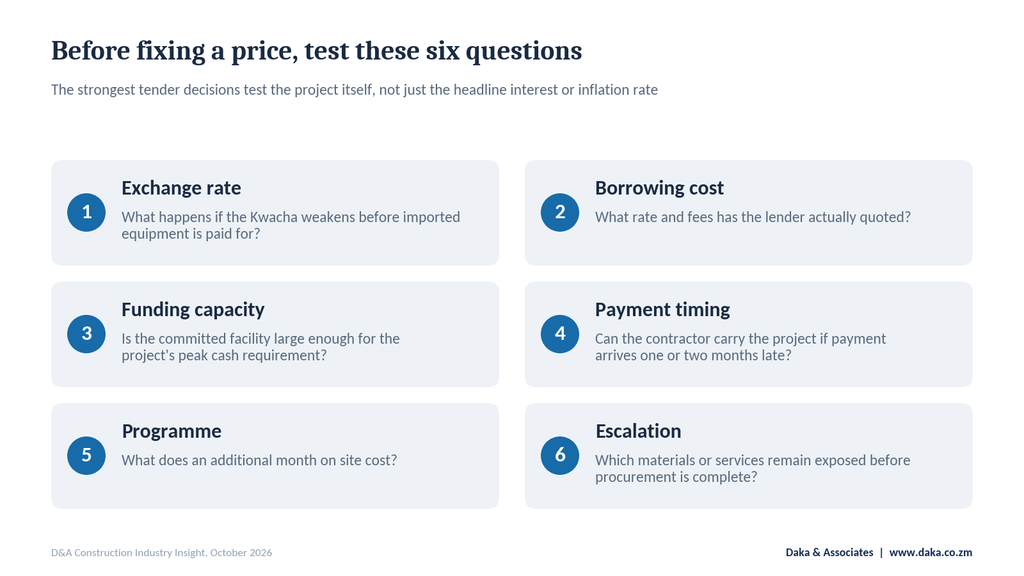
Together, these give a more useful commercial picture than any single inflation or interest-rate assumption.
Lower expected cost does not automatically mean a lower tender price
A tender price must cover economic delivery cost + project risk + financing + required return + competitive position. If procurement costs improve, a contractor may use some of that gain to rebuild margin, strengthen resources, add downside protection or reduce the chance of a loss. Competitive pressure may eventually push market prices down, but that should be a deliberate commercial decision. The goal is not simply to be cheaper. It is to submit a price that is both competitive and economically deliverable.
What construction businesses should do now
- Requote uncommitted imports at current exchange rates and supplier quotations, especially specialist equipment and MEP packages.
- Get current bank terms. Use the lender’s quoted rate, fees and conditions, not the Policy Rate.
- Test funding separately from interest. A project can be profitable and still unfundable.
- Refresh escalation assumptions with current ZPPA information, supplier quotations, fuel, labour and plant data, rather than carrying forward 2024–25 assumptions.
- Keep downside protection. Currency, fuel, electricity, payment and programme risks have eased in some respects, but none has gone away.
Our outlook for Q4 2026
The construction market is entering a better macroeconomic environment than it faced in early 2025. Inflation has normalised, the Kwacha is far stronger than at the worst of the currency stress, rates are falling, and bank asset quality has improved (the NPL ratio was 2.83% in March 2026, against 4.00% a year earlier).
But this is not yet cheap or abundant capital. The Kwacha weakened in Q3, commercial lending was still around 25% in the latest data, and access to working capital will decide whether viable projects actually get built.
The cost environment is improving faster than the funding environment. Contractors and developers who update supplier costs, manage open FX exposure, negotiate current financing terms and understand their true working-capital needs will be best placed to turn this into sustainable margins and resilient projects.
Data note: This article reflects information available to 1 October 2026. Commercial lending and sector-credit data are available to March 2026 and do not yet show the response to the September cut. We will refresh the financing section when post-MPC lending, interbank, T-bill or bank base-rate evidence is published.
Sources: Bank of Zambia September 2026 MPC statement; Bank of Zambia Quarterly Selected Macroeconomic Indicators (to Q1 2026); Bank of Zambia Overnight Lending Facility history; daily exchange-rate data.
Disclaimer: This article provides general construction-market information and does not constitute financial, legal, lending, procurement or project-specific tender advice.
Commercial disclosure: Daka & Associates provides construction brokerage, procurement, tender advisory, commercial modelling, project development and capital mobilisation services, and has a commercial interest in the market discussed.rocurement, tender advisory, commercial modelling, project development and capital mobilisation services.