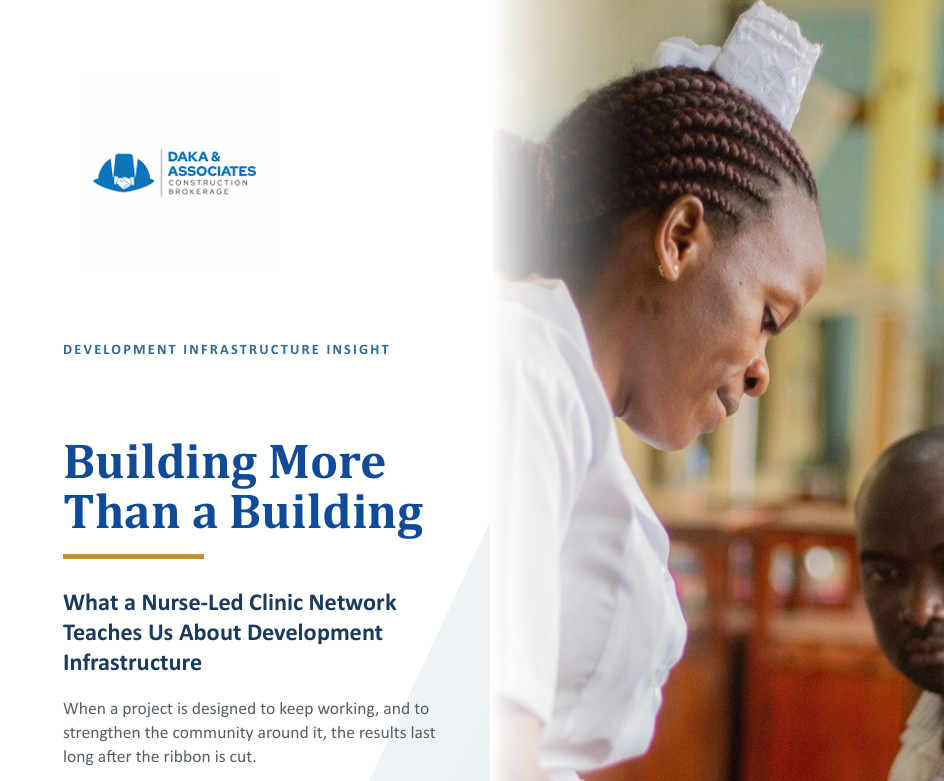
A clinic is more than a structure. Here is what the Unjani Clinic Network shows about designing infrastructure that keeps working after handover.
When a project is designed to keep working, and to strengthen the community around it, the results last long after the ribbon is cut.
A clinic is not only a structure
Many well-meant projects treat construction as the finish line. The grant is approved, the building goes up, and the ribbon is cut. But a building that is not used, staffed, maintained or funded becomes a burden. That is true of a clinic, and equally of a school, water point, sanitation block, training centre or community hall.
The Unjani Clinic Network in South Africa shows a different approach. Unjani identifies suitably qualified professional nurses, supports them with business skills and mentoring, and enables them to run accessible primary healthcare clinics. Many of the clinics use converted shipping containers. The container is not the main lesson. The owner-operator model built around it is.
According to current public materials and a July 2026 reported feature, the network shows 294+ care settings and has reported 8 million+ consultations and 880+ permanent jobs. It is targeting 600 clinics by the end of 2031.
Plan the building and what happens after handover together
In many projects the building is designed first and the operating problem is left for later. The Unjani model points the other way. It links a modest physical asset to a defined operator, a service proposition, business capability and ongoing support. The clinic footprint can stay simple because the sophistication sits in the system around it.
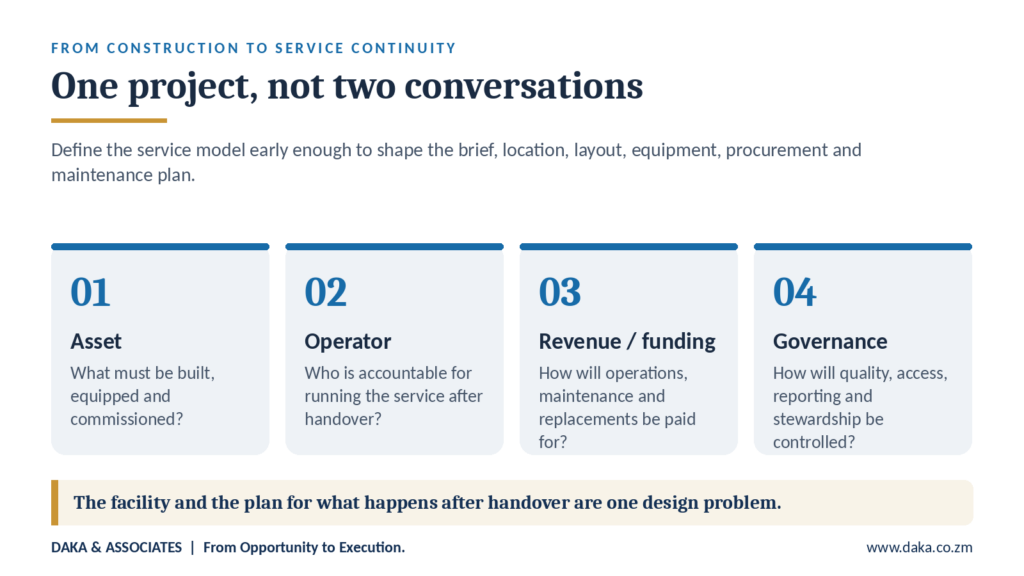
Four questions should be answered early enough to shape the brief, location, layout, equipment, procurement strategy and maintenance plan:
- Asset: What must be built, equipped and commissioned?
- Operator: Who is accountable for running the service after handover?
- Revenue and funding: How will operations, maintenance and replacements be paid for?
- Governance: How will quality, access, reporting and stewardship be controlled?
The physical asset and the plan to sustain it should be developed as one project, even when different parties deliver and operate it.
Every construction project is also a local economy
When a donor-funded or NGO-led project is built, the budget moves through a network of professionals, contractors, suppliers, workers, local enterprises and communities. That value can be accidental, or it can be designed. If participation is not designed before procurement, much of the wider economic value is left to chance.
Where good projects go wrong
The riskiest part of a social-infrastructure project is often not the idea or the funding approval. It is the step from funded intent to a project that is buildable, procured, verified and measurable. Four problems come up repeatedly:
- Unclear scope: the brief is too vague to price, tender or build without ambiguity.
- Weak procurement: contractors are chosen quickly, records are incomplete, or donor requirements never reach the tender controls.
- No independent checking: the contractor becomes the main source of evidence that work is complete and ready for payment.
- Poor impact capture: jobs, local spending and skills transfer are never systematically measured.
These are delivery-governance risks, not unavoidable conditions. Better project definition, transparent procurement, independent technical assurance and deliberate impact tracking can reduce them before they turn into claims, defects, delays or reputational problems.
Five ways NGOs can turn construction into lasting impact
The opportunity is not to add social language after construction. It is to build development objectives into the project architecture from the start.
- Eco-friendly materials: appropriate stabilised, recycled, locally produced or lower-carbon inputs, where performance and lifecycle value are proven.
- Training-to-work hubs: trade-skills development combined with real work exposure, giving trainees a credible route into construction employment.
- Affordable and resilient buildings: housing, settlement upgrading and community facilities that strengthen social resilience.
- WASH and environmental infrastructure: water points, toilets, drainage and waste systems that protect health.
- Local supply-chain integration: connecting local contractors, suppliers and artisans to real opportunities through procurement design.
Construction should be managed as a platform for service delivery, local economic participation and institutional capability, not only as a purchasing exercise.
Measure what was built and what it changed
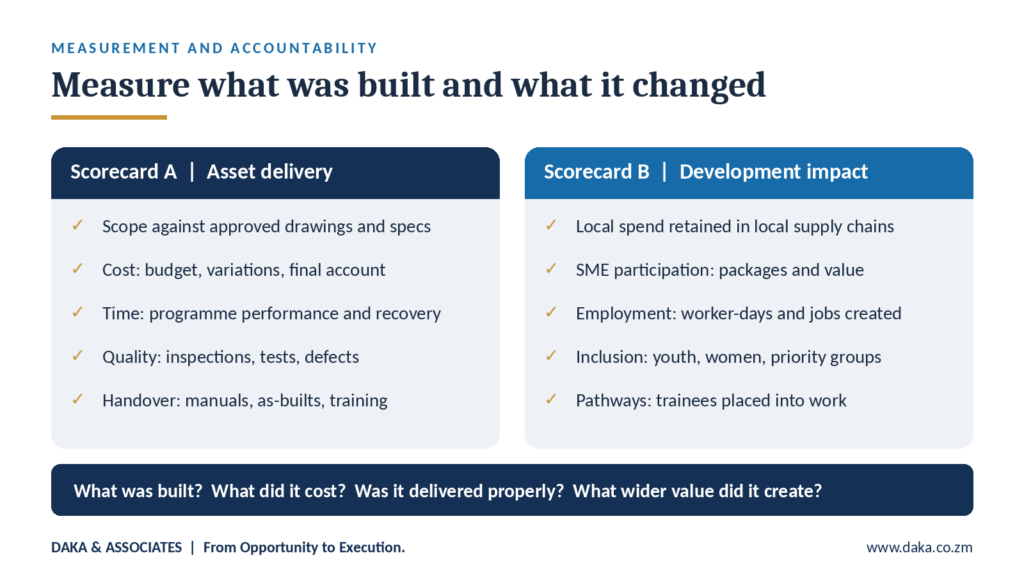
A finished building is necessary, but it is not the only measure of success. Boards, funders and programme managers should track two scorecards together. Scorecard A covers asset delivery: scope, cost, time, quality and handover. Scorecard B covers development impact: local spend, SME participation, employment, inclusion and pathways into work.
Together they let a funder answer four questions. What was built? What did it cost? Was it delivered properly? What wider value did it create?
Start with the right questions
Zambia does not only need more infrastructure. It needs infrastructure spending that strengthens the economy around it and leaves behind assets that stay useful after practical completion. Before committing capital, ask:
- Will it keep working? Who operates, funds, maintains and governs the asset after handover?
- Will it strengthen locally? How will contractors, suppliers, workers and trainees take part?
- Can we prove the value? What technical, commercial and impact evidence will the board or funder receive?
How Daka & Associates can help
We help development organisations structure, prepare, procure, verify and close out infrastructure, while the client keeps ownership of the mission and the final decisions. Our work covers project preparation, design, cost and procurement, construction management and technical assurance.
We recommend starting with a Project Readiness Review. It tests whether a project is genuinely ready for design, tender or construction, and it can expose scope gaps, missing approvals, unrealistic budgets and weak governance while they are still inexpensive to fix.
Planning a clinic, school, water project or community facility? Visit www.daka.co.zm to start a readiness conversation.
From Opportunity to Execution.
Sources: Unjani Clinics (About the NPC; Investor information; 2022 Annual Report) and News24 BrandStory, 29 July 2026. This article is a Daka & Associates interpretation of publicly reported case-study information. It is not an endorsement by, or publication of, Unjani Clinics.