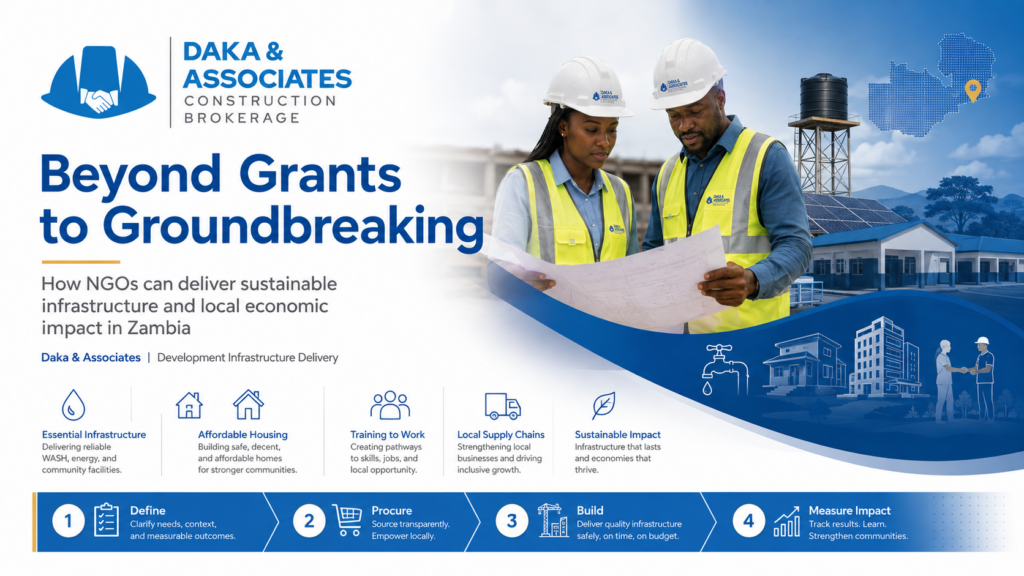
Beyond Grants: How NGOs Can Deliver Sustainable Infrastructure and Economic Opportunity in Zambia.
For many development organisations, infrastructure has traditionally been treated as an output.
A school is constructed. A health facility is rehabilitated. A borehole is installed. A changing room is completed. A vocational training centre is commissioned.
But infrastructure can do considerably more than provide the finished asset.
When project design, procurement, workforce development and local supply chains are considered together, a construction programme can simultaneously create infrastructure, employment, enterprise development, skills transfer and long-term community capacity.
That creates an important opportunity for NGOs, foundations, development agencies and corporate social-investment programmes operating in Zambia.
The question is no longer simply:
“What do we need to build?”
It is increasingly:
“How can the process of building it create additional development value?”
Zambia’s current Eighth National Development Plan places economic transformation and job creation, human and social development, environmental sustainability and good governance among its four strategic development areas. Infrastructure programmes can intersect with all four when they are deliberately structured to do so.
Infrastructure as a Development Platform
A donor-funded construction project contains an entire economic ecosystem.
There are architects and engineers.
There are contractors and subcontractors.
There are suppliers and manufacturers.
There are artisans and general workers.
There are young people looking for their first opportunity to enter the labour market.
There are women-owned businesses seeking access to supply chains.
There are local communities that can provide labour, materials and services.
There are institutions that will eventually operate and maintain the completed asset.
The development opportunity therefore extends beyond the building itself.
A well-designed project can intentionally direct part of its expenditure towards local firms, workforce development, women and youth participation, sustainable materials and practical skills transfer while maintaining appropriate quality, cost, safety and procurement controls.
This is particularly important because sustainable development procurement is not simply about selecting the lowest quotation. UNDP’s procurement framework, for example, expressly frames procurement around best value for money, fairness, integrity, transparency and effective competition, with social and environmental outcomes capable of forming part of value considerations.
Five Models Worth Exploring
1. Sustainable building-material enterprises
Development organisations can support enterprises manufacturing locally appropriate construction products such as compressed earth blocks, soil-stabilised blocks, recycled-plastic products, paving systems and other resource-efficient materials.
The opportunity is not merely environmental.
A commercially viable materials enterprise can create jobs, develop local manufacturing capacity and retain more construction expenditure within the communities and economies where development programmes operate.
Where such materials are proposed for permanent structures, however, affordability should never replace engineering suitability. Materials need appropriate specifications, testing, quality control and acceptance for their intended application.
2. Training-to-work construction programmes
Vocational training becomes considerably more powerful when training is connected to actual employment demand.
Instead of training people and hoping opportunities emerge afterwards, programmes can build a bridge from:
recruitment → training → practical exposure → work placement → certification → employment → enterprise development.
This approach is already visible in Zambia. Build It International, for example, combines construction-skills training with practical learning and work placements on contractor or building projects, illustrating how skills programmes can connect training with real industry exposure.
For development organisations, this opens an important possibility.
A community infrastructure programme can become both a capital project and a workforce-development platform.
A school rehabilitation programme could include apprenticeship opportunities.
A WASH programme could develop plumbing and water-systems technicians.
A housing programme could support bricklayers, carpenters, electricians and emerging subcontractors.
A multi-year infrastructure programme could leave behind not only assets, but an employable local workforce.
3. Affordable and community infrastructure enterprises
Social-enterprise structures can also be explored for affordable housing, sanitation, markets, community facilities and other infrastructure where a viable revenue stream exists.
Depending on the project, this may include service charges, lease structures, rental models, maintenance subscriptions, institutional off-take arrangements or blended financing.
Not every development project should become a commercial enterprise.
But where revenue can reasonably support operations and maintenance, the social-enterprise model can reduce the familiar development problem of constructing an asset without adequately funding its life after handover.
4. WASH and environmental infrastructure
Water and sanitation projects provide another strong opportunity for integrated development models.
Construction can be combined with local operator training, maintenance systems, community engagement, environmental safeguards and, where appropriate, sustainable service-charge mechanisms.
The same principle applies to waste-management infrastructure, drainage, recycling facilities and decentralised environmental services.
The objective should be to move from:
“build and hand over”
to:
“design, build, operate sustainably and measure impact.”
5. Local construction supply-chain integration
This may be one of the largest untapped opportunities.
A development organisation does not necessarily need to establish its own construction company to increase local participation in infrastructure delivery.
Instead, its projects can deliberately create structured entry points for:
- Zambian contractors;
- specialist subcontractors;
- women-owned businesses;
- youth-led enterprises;
- local suppliers;
- artisans;
- graduates and trainees; and
- community-based service providers.
The challenge is doing this without compromising competition, technical standards or accountability.
That requires market mapping, prequalification, tender documentation, transparent evaluation, contract administration, quality assurance and performance monitoring.
In other words, localisation requires a delivery system.
The Missing Middle Between Development Funding and Construction Delivery
This is where many otherwise strong development programmes encounter difficulty.
The organisation may understand the social problem extremely well.
The donor understands the funding requirements.
An architect can produce a design.
A contractor can construct the works.
But somebody must still manage the space between all of them.
Who validates the project brief?
Who tests whether the budget is realistic?
Who verifies quantities?
Who develops procurement documentation?
Who identifies capable local firms without predetermining the competition?
Who evaluates technical proposals?
Who checks whether the selected contractor is appropriately registered?
Who verifies work before payment?
Who monitors defects?
Who tracks participation by youth, women and local enterprises?
Who produces the audit trail demonstrating what development value was actually created?
For donor-funded construction, the delivery architecture matters almost as much as the physical architecture.
From Contractor Appointment to Delivery Architecture
A stronger model separates the critical functions of a project.
The development organisation retains ownership of the mission, funding objectives and final decisions.
The design team develops the technical solution.
The contractor executes the physical works.
The independent project-delivery and technical-assurance function protects the client’s interests through procurement, cost control, supervision, verification, reporting and contract administration.
And where employment or local economic development is part of the programme, a structured workforce and supplier-development layer connects construction expenditure with the intended social outcomes.
This separation strengthens accountability.
It also reduces the risk of asking one participant to simultaneously design the solution, select itself to deliver it, assess its own performance and certify its own work.
A Note on Regulation and Organisational Structure
Development organisations considering commercial or social-enterprise activities should obtain project-specific legal, tax and regulatory advice before implementation.
As of August 2026, Zambia’s Ministry of Community Development and Social Services continues to administer NGO registration under the Non-Governmental Organisations Act No. 16 of 2009, while the proposed 2025 replacement Bill was deferred for further stakeholder consultation. PACRA separately administers registration of companies and other business entities. A separately incorporated commercial vehicle may therefore be appropriate for some social-enterprise models, but the correct structure depends on the activity, governance model, tax treatment, funding agreements and regulatory requirements concerned.
Construction activities also need to be structured around relevant sector requirements. The National Council for Construction maintains contractor and supplier registration systems and states that construction projects are required to be registered with NCC before commencement of works.
The practical lesson is simple:
social innovation does not remove the need for procurement, engineering, financial and regulatory discipline.
It makes that discipline more important.
The Opportunity for Zambia’s Development Sector
Imagine a donor financing five community facilities.
Under a conventional model, five buildings are completed.
Under an integrated development-infrastructure model, the same programme could potentially produce:
five completed facilities;
a competitively procured group of capable Zambian contractors;
structured opportunities for local MSMEs;
work placements for vocational trainees;
participation targets for women and young people;
documented skills transfer;
stronger contractor safety and quality systems;
measurable local procurement;
and a supplier and workforce database that supports the next programme.
The infrastructure remains the output.
But economic participation becomes part of the outcome.
That is the shift development organisations can begin designing into their projects.
Where Daka & Associates Fits
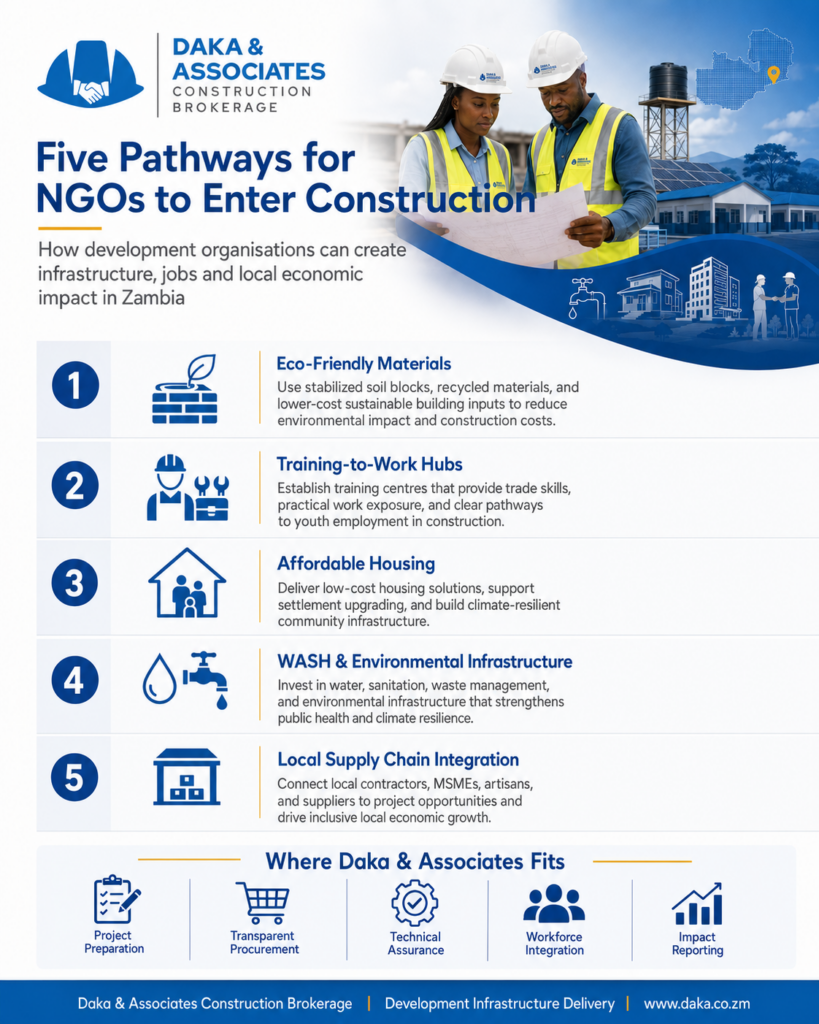
Daka & Associates Construction Brokerage Limited works in the space between development intent and construction execution.
Our existing construction-brokerage model connects clients with contractors, skilled workers, procurement support, project oversight, risk assessment and construction advisory services. For the development sector, we are extending that capability into a dedicated NGO & Development Infrastructure Delivery proposition.
We can support NGOs, foundations, embassies, implementing partners and donor-funded programmes with:
- project definition and technical scoping;
- consultant and contractor procurement;
- Bills of Quantities and cost planning;
- contractor sourcing and prequalification;
- competitive tender administration;
- technical and financial bid evaluation support;
- project management;
- independent site supervision and quality assurance;
- milestone and payment verification;
- local supplier and MSME integration;
- construction workforce mobilisation;
- training-to-work and work-placement coordination;
- gender-responsive construction strategies;
- OHS and safeguarding integration;
- project reporting and development-impact tracking; and
- post-completion defects and close-out management.
For donor-funded assignments, our preferred model is transparent and client-side: evaluation criteria are established before procurement, conflicts are declared, recommendations are documented, and construction appointments remain subject to the client’s approved procurement process.
Daka & Associates is also a signatory to the Women’s Empowerment Principles, supporting our commitment to advancing women’s participation in workplaces, marketplaces and economic opportunities connected to the built environment.
We do not believe every NGO needs to become a construction company.
We believe development organisations need access to a reliable infrastructure-delivery ecosystem that allows them to build confidently while retaining focus on their mission.
Call to action
Planning a development infrastructure project in Zambia?
Whether you are developing a school, health facility, changing room, training centre, WASH system, community facility or multi-site infrastructure programme, Daka & Associates can help structure the journey from concept and procurement through construction and handover.
Speak to Daka & Associates about an Infrastructure Delivery Diagnostic or Project Readiness Review.