A market entry strategy Zambian contractors have overlooked and why that’s about to change.
The Uncomfortable Truth About the Zambian Contractor Market
Pull the National Construction Council’s march 30th 2026 register and a picture emerges that most contractors feel in their bones but have never seen in black and white: 80.5% of all registered contractors in Zambia sit in Grades 5 and 6. That’s 8,140 firms out of roughly 10,100 registered nationally all fighting over the smallest, lowest-margin contracts in the industry.
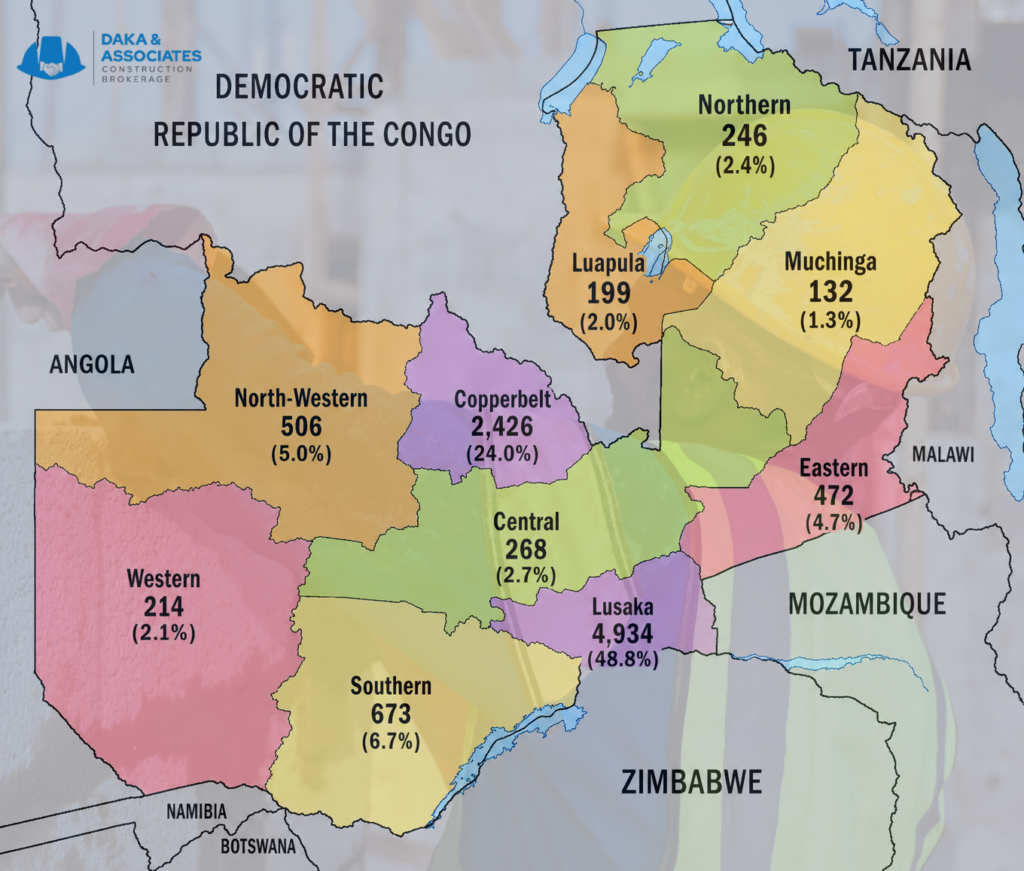
Layer on the geography and it gets worse. 72.8% of all contractors are crammed into just two provinces; Lusaka and the Copperbelt. If you’re a Grade 5 or 6 building contractor in Lusaka, you are not competing against a handful of rivals. You are one of thousands, bidding into a race-to-the-bottom pricing war where the only lever left to pull is margin; your margin (Numbers dont Lie).
Meanwhile, at the top of the pyramid, something almost nobody talks about is happening: in Grade 1, foreign firms outnumber Zambian firms two-to-one (287 foreign registrations against 143 Zambian). Chinese firms alone hold 191 registrations across all grades. These are the contractors capturing Zambia’s unlimited-value infrastructure, mining, and road contracts, the K150 million-plus tenders where real wealth is built.
So here is the question every Zambian contractor should be asking themselves in 2026:
If the bottom of the market is oversaturated and the top is dominated by foreign capital, why is almost everyone still trying to climb the ladder one grade at a time; when there’s a faster door?
That door is acquisition. And right now, almost nobody in Zambian construction is walking through it.
Why “Build From Scratch” Is the Hard Way
The conventional path to scale in Zambian construction looks like this: register at Grade 6, complete a project worth at least 50% of your grade’s tender ceiling, apply to upgrade, repeat. To reach Grade 1 or 2, NCC rules require at least two completed projects, each worth 50% of your current grade’s limit, within the past five years; plus a turnover track record to match.
For a Category B contractor, that means climbing from a K4 million ceiling at Grade 6 all the way to an unlimited license at Grade 1, a journey that, done organically, realistically takes 7 to 12 years, assuming you win consistent work in an already-flooded field the entire time.
And even if you make it, you inherit nothing. No fleet. No backlog. No relationships with financiers or clients built over a decade. You built it all yourself, slowly, while thousands of competitors did the same thing in the same two provinces.
There is a faster way and it’s the same one that mining houses, telecoms groups, and private equity funds use every day to enter markets they don’t want to build from zero: you buy the ladder instead of climbing it.
The Alternative Nobody’s Talking About: Acquisition Over Greenfield
Buying an existing, actively graded construction company does something no amount of organic bidding can do overnight; it transfers the license, the fleet, the backlog, and the track record to you on day one.
Consider what a single acquisition actually hands you:
- An active NCC grading; potentially Grade 1 or 2, with unlimited or near-unlimited tender ceilings, inherited immediately rather than earned over a decade.
- An operational equipment fleet; already cleared through Zambian customs, bypassing the 7–10 week TAZARA import corridor or the 3–5 week Durban route entirely.
- An existing project backlog and client relationships; active cash-flowing contracts rather than a cold start.
- A trained, NCC-qualified technical workforce, including the registered engineers required to legally hold the grading.
Compare that to the cost of building it yourself: years of sub-scale bidding in the most crowded segment of the market, capital tied up in imported machinery, and no guarantee the NCC upgrade process even succeeds on schedule.
The market has already priced this trade-off. Small-scale contractors (6–25 employees) typically trade at 2.9x to 3.5x EBITDA meaning an established, cash-generating Grade 2 or 3 firm can often be acquired for a multiple that pays for itself out of the very contracts it already holds.
The Consortia Angle: Solving the Grade 1 Problem Together
Acquisition doesn’t have to mean one buyer, one target. For Zambian firms looking at the Grade 1 imbalance where foreign capital outnumbers local firms two-to-one, the more powerful play is consortia-based acquisition: groups of established Zambian contractors pooling capital to jointly acquire or recapitalize a higher-grade entity, rather than each firm fighting alone at Grade 5 or 6.
This does three things at once:
- It concentrates local capital against foreign-dominated Grade 1 competition instead of letting it stay fragmented across thousands of small Grade 5/6 players.
- It satisfies the Public Procurement Act’s citizen-participation preferences; Zambian-owned consortium structures can access preferential tender reservation thresholds that foreign-majority firms cannot.
- It shares due diligence and transaction cost across multiple partners, making a Grade 1 or Grade 2 acquisition financially reachable for firms that could never fund it solo.
A consortium that jointly acquires a Grade 2 civil engineering firm rather than five separate firms each grinding through a decade-long Grade 6-to-2 climb reaches the K150 million tender ceiling in months, not years, and does it with genuine Zambian ownership behind the license.
How the Transaction Actually Works
This is not exotic. The mechanics are well-established under Zambian corporate law, even though few contractors have used them:
- Execute a Share Sale & Purchase Agreement with the target’s shareholders.
- Settle Property Transfer Tax (8%) with ZRA and obtain a PTT Clearance Certificate; without this, PACRA cannot process the transfer.
- File PACRA Form 18 (transfer of shares, in duplicate) and Form 20 (change of shareholding/beneficial ownership) within 14 days of execution.
- File Form 21 (beneficial ownership declaration) within 30 days.
- File Form 10 (director changes) within 21 days if the board is restructured.
The full regulatory sequence; share transfer to full PACRA registration is a matter of weeks, not years. Set against a decade-long organic upgrade path, that timeline advantage alone should be enough to change how contractors think about growth.
The Due Diligence That Protects You
Acquisition isn’t risk-free; it’s a different risk profile than organic growth. The firm you buy carries whatever history it has: undisclosed tax exposure, disputed retentions, or an equipment fleet that was never properly cleared through customs. The protection is a disciplined due diligence process covering:
- NCC grading verification; confirming the license is active and the qualifying technical shareholder is retained post-sale.
- Tax clearance and MAT exposure; a forensic review of ZRA filings, not just a clearance certificate on its face.
- Fleet and asset integrity; matching serial numbers to white books and confirming customs clearance.
- Backlog quality; auditing active contracts for liquidated damages exposure and retention terms.
- Key personnel retention agreements; securing the registered engineers the license depends on before, not after, the deal closes.
Done properly, this is a controlled, professional process and not a gamble.
The Bottom Line
Zambia’s construction market has a structural imbalance: thousands of firms fighting for K4–6 million contracts at the bottom, and foreign capital dominating the unlimited-value tier at the top. Organic growth through the NCC grading ladder was built for a market with less competition than exists today. It still works, it’s just slow, capital-intensive, and increasingly crowded.
Acquisition is the path that’s been sitting in plain sight the entire time, used routinely by every other capital-intensive sector in Zambia, and almost entirely ignored in construction. For contractors serious about reaching Grade 1 or 2 territory, or for groups of established firms ready to pool resources into a consortium acquisition, the question is no longer whether this route works. It’s why more Zambian contractors haven’t taken it yet.