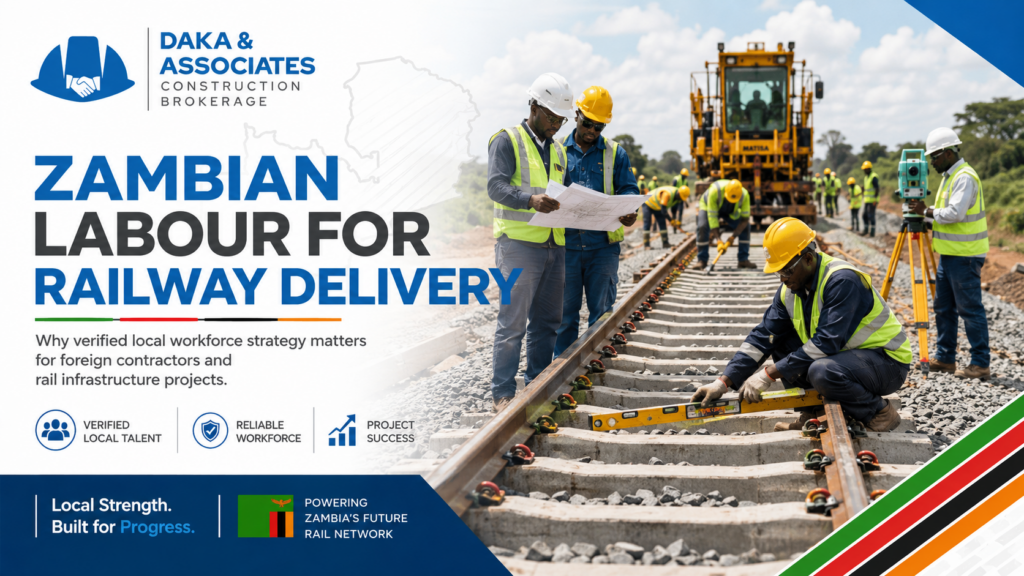
Why verified Zambian labour placement is becoming a strategic advantage for construction, infrastructure, mining, energy, road, and railway projects
Zambia is entering an important infrastructure moment.
Across the country, opportunities are emerging in roadworks, drainage infrastructure, mining support facilities, industrial buildings, public infrastructure, energy projects, commercial developments, logistics facilities, and railway corridors. For foreign contractors, EPC firms, international developers, equipment-backed contractors, and regional construction companies, Zambia offers a serious project pipeline.
But Zambia is not a market where contractors should arrive late, price thinly, and assume that labour can simply be found at the gate.
The contractors most likely to succeed will be those that understand one critical point early:
In Zambia, construction labour is not just manpower. It is project delivery risk.
The success of a construction project depends not only on finance, equipment, designs, and contracts. It also depends on whether the contractor can access reliable, verified, compliant, and productive local workers who are ready for the realities of the site.
This is where construction labour placement becomes strategic.
For foreign contractors taking on current projects or prospecting for upcoming work in Zambia, a strong local labour strategy can reduce mobilisation delays, improve productivity, support compliance, protect margins, and strengthen client confidence.
Zambia Is Becoming a Corridor and Infrastructure Market
Zambia’s construction opportunity is increasingly tied to its geographic position.
The country sits at the centre of regional trade routes connecting Southern Africa, Central Africa, East Africa, and the Atlantic corridor through Angola. As demand grows for copper, cobalt, critical minerals, agricultural logistics, industrialisation, and regional trade, Zambia’s infrastructure requirements are expanding.
This creates opportunities across several construction categories:
- road rehabilitation and upgrading;
- drainage and bridge works;
- mining infrastructure;
- industrial yards and logistics hubs;
- energy and transmission-related civil works;
- commercial and public buildings;
- railway rehabilitation and expansion;
- border infrastructure;
- warehousing and inland transport facilities;
- worker camps and project support facilities.
For foreign contractors, this means Zambia should not be viewed only as a single-project market. It should be viewed as a long-term infrastructure participation market.
The contractors that build credible local systems now will be better positioned for future tenders, partnerships, and repeat work.
Railway Projects Are a Signal of What Is Coming
One of the strongest indicators of Zambia’s infrastructure direction is the renewed focus on railway and logistics corridors.
Railway-related construction is strategically important because it links mining output, regional trade, port access, and industrial development. It also creates a wide range of construction needs beyond the railway line itself.
Upcoming and emerging railway-related opportunities may involve:
- rail formation and earthworks;
- ballast and sleeper works;
- track laying and alignment;
- culverts and drainage crossings;
- bridge and embankment works;
- station and depot upgrades;
- access roads and service roads;
- signalling-related civil works;
- fencing and corridor protection;
- worker camps and site facilities;
- warehousing and logistics infrastructure;
- maintenance yards;
- power and utility support works.
These projects are labour-intensive, technically demanding, and often spread over long linear construction fronts. They require well-organised crews, careful supervision, reliable attendance, strong safety discipline, and structured payroll systems.
This is exactly the kind of environment where informal labour recruitment becomes risky.
A rail corridor cannot be delivered effectively by unverified workers collected at the last minute. It requires a workforce strategy that is prepared before mobilisation.
Why Foreign Contractors Should Pay Attention to the Lobito Corridor
The Lobito Corridor is one of the most important regional infrastructure developments affecting Zambia’s future logistics position.
The corridor is intended to strengthen connectivity between Zambia, the Democratic Republic of Congo, Angola, and the Atlantic port of Lobito. For Zambia, this has major implications for mining exports, logistics efficiency, trade competitiveness, and regional integration.
The planned Chingola-to-Angola rail connection is particularly important because it would improve Zambia’s western logistics route and create new demand for construction, labour, supply chain services, and local project support.
For foreign contractors, the Lobito Corridor is not only a railway story. It is a construction ecosystem story.
It points to likely future demand for:
- rail contractors;
- earthworks contractors;
- civil works subcontractors;
- bridge and culvert teams;
- survey crews;
- materials testing teams;
- drainage specialists;
- plant operators;
- welders and steel workers;
- safety officers;
- local labour brokers;
- community liaison support;
- payroll and compliance systems;
- logistics and camp-support services.
Foreign contractors that want to participate in corridor-related works need to prepare local labour capacity early. Waiting until award can create mobilisation pressure, community tension, and weak productivity during the most critical early stage of the project.
TAZARA Revitalisation Also Matters
The Tanzania-Zambia Railway Authority corridor remains one of Zambia’s most important transport routes. It links Zambia to the port of Dar es Salaam and provides an alternative export and import route for mining, industrial, and bulk cargo.
The planned revitalisation of TAZARA signals renewed attention to rail as a strategic infrastructure asset.
For contractors, this kind of rail rehabilitation does not only create opportunities in track works. It may also stimulate associated construction requirements along the corridor, including:
- depot rehabilitation;
- drainage improvements;
- station upgrades;
- bridge repairs;
- maintenance facilities;
- access roads;
- workshops;
- storage yards;
- worker accommodation;
- electrical and mechanical support infrastructure;
- safety and environmental works.
Projects of this nature require disciplined workforce planning. Rail rehabilitation also often happens in operational corridors, where safety, access control, coordination, and sequencing are critical.
A poorly selected labour force can cause delays, accidents, damage to existing assets, and quality failures. A well-selected local workforce can help contractors deliver faster, safer, and with stronger community acceptance.
Railway Works Are Only One Part of the Construction Opportunity
Although railway construction is a major emerging opportunity, the message is broader.
Zambia’s infrastructure pipeline is not limited to rail. Foreign contractors are also likely to encounter opportunities in:
- mining access roads;
- haul roads and industrial roads;
- township roads;
- drainage channels;
- culverts and bridges;
- public buildings;
- hospitals and clinics;
- schools and education facilities;
- energy infrastructure;
- water and sanitation projects;
- warehouses and logistics centres;
- industrial sheds;
- commercial developments;
- housing and worker accommodation.
Each of these sectors has different technical labour demands. A road project may require plant operators, grader operators, asphalt teams, drainage teams, survey assistants, and compaction crews. A building project may require masons, carpenters, plasterers, electricians, plumbers, steel fixers, scaffolders, painters, and finishing teams. A mining support facility may require welders, riggers, equipment operators, steel erectors, concrete crews, and safety personnel.
The common requirement is the same:
workers must be verified, organised, documented, paid correctly, and matched to the project’s technical requirements.
That is the foundation of construction labour brokerage.
The Risk of Informal Hiring in Zambia
Many contractors underestimate the risk of informal hiring.
Informal recruitment may seem attractive because it is fast, flexible, and appears cheaper at the start. Workers can be sourced through site gates, middlemen, local contacts, or community referrals. But this approach creates major risks.
The typical risks include:
- workers overstating their skills;
- no proper trade testing;
- weak safety culture;
- inconsistent attendance;
- high turnover;
- poor workmanship;
- rework and rejected works;
- weak accountability;
- wage disputes;
- unclear employment terms;
- community pressure;
- payroll non-compliance;
- weak documentation for audits or claims.
For foreign contractors, these risks are amplified because they may not fully understand the local labour market, statutory requirements, wage expectations, community dynamics, and documentation standards.
A contractor may save money during recruitment but lose much more through rework, accidents, labour disputes, delayed certification, or project disruption.
The lowest labour rate is not always the lowest labour cost.
Why General Staffing Agencies May Not Be Enough
General staffing agencies can help with basic recruitment and administration. They may be useful for office staff, general support staff, or broad human-resource functions.
But construction labour placement requires technical understanding.
It is not enough to know that a worker is available. The contractor must know whether that worker can actually perform the task safely, productively, and to the required standard.
A general staffing agency may not be able to assess whether:
- a steel fixer can read reinforcement details;
- a carpenter can set out formwork correctly;
- a mason can achieve the required finish;
- a welder is suitable for structural steel works;
- a plant operator is safe and productive;
- a survey assistant understands site control procedures;
- a drainage crew can follow levels and gradients;
- a finishing worker can meet client expectations;
- a worker is suitable for a hospital, mine, road, railway, or industrial environment.
This is why construction-specific labour brokerage is different.
It connects recruitment with engineering judgment, trade assessment, site requirements, and project delivery needs.
The Role of a Specialist Construction Labour Broker
A specialist construction labour broker supports contractors by making labour placement more structured, technical, and compliant.
For foreign contractors entering Zambia, this role can include:
- identifying available local workers;
- classifying workers by trade and experience;
- verifying identity documents;
- checking certificates and qualifications;
- arranging trade testing where required;
- building standby labour rosters;
- aligning workers to BoQ items and work packages;
- supporting local employment planning;
- coordinating onboarding;
- supporting payroll records;
- replacing unsuitable workers quickly;
- assisting with attendance and productivity tracking;
- supporting safety induction and compliance documentation.
This gives the contractor a stronger workforce system from the beginning.
Instead of reacting to labour problems after mobilisation, the contractor enters the project with a prepared labour pipeline.
Labour Planning Should Start During Tendering
Foreign contractors often begin thinking seriously about labour after they win a project. This is too late.
Labour planning should begin during tendering.
During bid preparation, contractors need to estimate the real cost of labour, identify the required trades, determine which skills are available locally, understand statutory costs, and assess the risk of mobilisation delays.
A strong labour brokerage partner can help contractors answer critical tender-stage questions:
- Which trades are available locally?
- Which trades may need training or external sourcing?
- What is the realistic wage range?
- What statutory costs must be added?
- How many workers are needed per work package?
- What is the likely mobilisation period?
- Are there community employment expectations?
- Can worker availability be documented?
- Are there qualified supervisors available?
- What backup rosters can be prepared?
This makes the bid more realistic.
It also helps prevent the common problem where a contractor wins a project based on a low labour cost assumption, then discovers during mobilisation that the actual labour cost is higher, productivity is lower, and statutory obligations were underpriced.
The Problem of “Ghost Crews” in Tendering
In major tenders, contractors may be required to submit named personnel, supervisors, specialists, and technical staff.
This can create a temptation to list personnel who are not genuinely available, not properly verified, or not committed to the contractor. In some cases, the same person may appear across multiple bids. This creates serious tender risk.
For foreign contractors, a specialist labour broker can help reduce this risk by preparing:
- verified CVs;
- signed availability confirmations;
- identity documentation;
- certificate checks;
- trade classification records;
- standby rosters;
- substitute personnel lists;
- project-specific workforce registers.
This gives the contractor stronger evidence of readiness.
It also helps show clients and evaluators that the contractor has taken local mobilisation seriously.
Zambia’s Labour Compliance Environment Must Be Built Into the Price
A major mistake foreign contractors make is pricing labour based only on the visible wage.
In Zambia, labour cost includes more than daily or monthly pay. Contractors must also consider statutory obligations, payroll administration, employment documentation, safety requirements, insurance, and worker records.
A responsible labour cost model should account for:
- employment contracts;
- NAPSA contributions;
- NHIMA contributions;
- PAYE administration;
- Workers’ Compensation requirements;
- Skills Development Levy;
- leave and termination obligations where applicable;
- overtime rules;
- payslip preparation;
- attendance records;
- safety induction costs;
- personal protective equipment;
- training and trade testing;
- transport or accommodation where required;
- supervision and replacement costs.
If these items are not included in the bid, they will still appear during construction. The only difference is that they will appear as unplanned cost pressure.
Foreign contractors need to understand that compliance is not optional overhead. It is part of the real economic cost of delivering construction work in Zambia.
Payroll Engineering Is Now a Project Control Issue
Payroll is often treated as an administrative function. On construction projects, it is much more than that.
Payroll affects worker morale, attendance, compliance, cash flow, disputes, productivity, and audit readiness.
In Zambia, construction workers may be paid through bank transfers, mobile money, or other structured payment channels. Mobile money can be especially useful for workers in remote areas or workers without easy banking access.
However, mobile money must not become informal payroll.
Every payment should still be linked to:
- worker identity;
- attendance records;
- timesheets;
- wage rates;
- deductions;
- employer contributions;
- payslips;
- payment date;
- project cost code;
- work package;
- statutory reporting records.
This is important because foreign contractors may later need to prove labour costs in payment applications, claims, variation submissions, donor audits, tax reviews, or client reporting.
A good payroll system protects both the worker and the contractor.
Local Labour Is Also a Community Relations Strategy
Construction projects do not happen in isolation. They happen in communities.
In Zambia, local communities often expect employment opportunities from projects taking place in their area. This is especially true for roadworks, railway corridors, mining projects, public infrastructure, and large civil works.
Foreign contractors that ignore local labour expectations may face resistance, complaints, reputational issues, or work interruptions.
But local employment must be managed properly.
Hiring unverified workers only to satisfy pressure can damage productivity and safety. The better model is structured local labour inclusion.
This means:
- identifying local workers early;
- screening them by skill level;
- matching them to suitable tasks;
- training where necessary;
- documenting employment terms;
- paying workers correctly;
- maintaining safety standards;
- communicating clearly with local stakeholders.
This approach supports local participation without compromising project quality.
A specialist construction labour broker can help foreign contractors balance community expectations with technical delivery requirements.
Why Railway and Linear Infrastructure Require Stronger Labour Systems
Railways, roads, pipelines, transmission lines, and drainage corridors are different from ordinary building sites.
They are linear projects. Work fronts move. Crews may be spread over long distances. Supervisors may not see every worker every hour. Attendance, logistics, safety, and payroll become harder to control.
This creates specific labour risks:
- workers failing to report at remote work fronts;
- poor coordination between teams;
- weak tracking of daily output;
- difficulty replacing workers quickly;
- inconsistent safety practices;
- poor documentation of labour deployment;
- challenges paying workers across multiple locations;
- disputes over days worked or tasks completed;
- community issues along the corridor.
For railway and road contractors, labour brokerage should therefore be linked to project controls.
The contractor should know:
- who is working;
- where they are working;
- what task they are assigned to;
- what output is expected;
- who supervises them;
- what they were paid;
- what deductions were made;
- what safety induction they received;
- whether they are available for the next work front.
This is the difference between labour recruitment and labour management.
The Contractor’s Pre-Mobilisation Checklist
Before mobilising on a Zambian construction project, foreign contractors should ask themselves the following questions:
- Have we identified the local trades required for each work package?
- Have we verified which workers are skilled, semi-skilled, or general labour?
- Have worker identities and certificates been checked?
- Have we priced statutory labour costs correctly?
- Have we prepared employment documentation?
- Have we planned for NAPSA, NHIMA, PAYE, Workers’ Compensation, and payroll records?
- Have we built a standby roster for replacements?
- Have we considered community employment expectations?
- Have we aligned labour teams to the BoQ and programme?
- Have workers received site-specific safety induction?
- Can we pay workers efficiently and document every payment?
- Can we support labour cost evidence for claims, audits, and payment certification?
If these questions are not answered before mobilisation, the contractor is entering the project with avoidable risk.
How Daka & Associates Construction Brokerage Can Support
Daka & Associates Construction Brokerage is positioned to support contractors that need reliable local workforce solutions for construction delivery in Zambia.
The value is not simply finding workers. The value is helping contractors build a labour system that supports delivery.
This includes support across four main stages.
1. Tender and Market Entry Support
Before a contractor bids or enters Zambia, Daka & Associates can support early labour planning by helping identify available local trades, likely wage expectations, workforce risks, and mobilisation requirements.
This helps foreign contractors price labour more realistically and prepare stronger tender submissions.
2. Workforce Verification and Readiness
Daka & Associates can support the identification, screening, and classification of workers by skill area. This helps contractors reduce the risk of unqualified workers arriving on site and causing quality or productivity problems.
The goal is to match workers to the actual construction task, not just to a job title.
3. Mobilisation and Site Deployment
Once the project is awarded, Daka & Associates can support worker onboarding, documentation, safety preparation, local engagement, and deployment planning.
This helps contractors avoid slow mobilisation and reduces early-stage confusion on site.
4. Payroll and Labour Compliance Support
Daka & Associates can support structured worker records, attendance tracking, payment documentation, and payroll coordination so that contractors can maintain cleaner records and reduce disputes.
This is especially important for foreign contractors that need audit-ready systems and clear labour cost evidence.
Why This Matters Commercially
Foreign contractors often focus heavily on equipment, material prices, subcontractors, and exchange rates. These are important. But labour can quietly destroy project margins if it is not managed properly.
Poor labour planning can lead to:
- slow mobilisation;
- excessive idle plant;
- low output;
- poor workmanship;
- rejected works;
- rework;
- labour disputes;
- safety incidents;
- community tension;
- delayed payment certification;
- non-compliance penalties;
- reputational damage.
Good labour planning can deliver the opposite:
- faster mobilisation;
- better productivity;
- stronger quality control;
- fewer disputes;
- better worker discipline;
- improved safety;
- stronger community acceptance;
- cleaner payroll records;
- better claim support;
- more predictable project delivery.
This is why labour placement should be treated as a commercial protection tool.
Zambia Needs Foreign Contractors, But Foreign Contractors Need Local Systems
Zambia’s infrastructure needs are real. The country needs capable contractors, technical expertise, capital, equipment, and delivery capacity.
Foreign contractors can play an important role in delivering the next generation of Zambian infrastructure.
But success requires localisation.
Localisation does not mean lowering standards. It means building systems that combine international project delivery discipline with local workforce participation, local compliance, and local market knowledge.
A contractor that enters Zambia with strong local labour systems will be better positioned than one that treats labour as an afterthought.
Final Message to Foreign Contractors
Zambia’s construction market is moving into a new phase.
Rail corridors, roadworks, mining infrastructure, industrial projects, public facilities, energy works, and logistics developments are creating opportunities for contractors that can deliver with speed, compliance, and quality.
But delivery will depend on people.
Foreign contractors must not wait until mobilisation to think about labour. They should build a verified local workforce strategy before bidding, before contract award, and before arriving on site.
The future of construction delivery in Zambia will favour contractors who can combine finance, equipment, engineering, and local labour capability into one integrated delivery system.
That is where specialist construction labour brokerage becomes valuable.
Because in Zambia, the right labour strategy is not just about employment.
It is about project success.