By Engineer Daka Harrison
Chief Executive Officer
Daka and Associates Construction Brokerage Limited
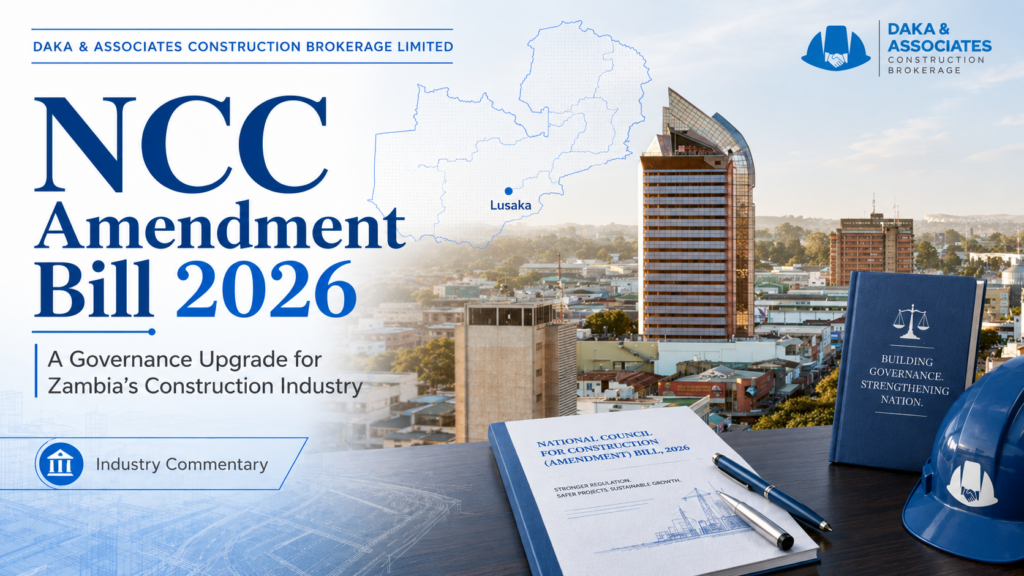
The National Council for Construction (Amendment) Bill, 2026 represents a targeted but important step in modernising Zambia’s construction regulatory framework. While the Bill does not overhaul the entire National Council for Construction Act No. 10 of 2020, it introduces governance changes that could improve institutional alignment, professional representation, administrative efficiency, and stakeholder participation within the National Council for Construction.
For Daka and Associates Construction Brokerage Limited, this amendment should be viewed as a governance upgrade. Construction regulation is not merely a legal or administrative function. It directly affects infrastructure delivery, contractor performance, public safety, project quality, cost accountability, employment creation, and investor confidence. The quality of governance at the National Council for Construction therefore matters to every contractor, consultant, developer, public institution, worker, and end-user of infrastructure in Zambia.
Professional Alignment and Cost Accountability
One of the key amendments is the replacement of outdated references to the Quantity Surveyors Registration Board with the Zambia Institute of Quantity Surveyors, established under the Zambia Institute of Quantity Surveyors Act, 2024.
This may appear to be a technical legal update, but it has practical significance. Quantity surveyors play a central role in cost planning, tender evaluation, valuation of works, contract administration, claims assessment, project financial control, and value-for-money assurance. Aligning the NCC governance framework with the current professional body strengthens the relationship between construction regulation and professional cost-management standards.
In an industry where cost overruns, weak tender pricing, poor valuation practices, delayed payments, and contractual disputes remain common challenges, the voice of quantity surveying is essential.
A Broader and More Representative NCC Board
The proposed restructuring of the NCC Board is one of the most important elements of the Bill. The Bill proposes representation from ministries responsible for infrastructure and local government, the Attorney-General, the Engineering Institution of Zambia, the Zambia Institute of Architects, the Zambia Institute of Quantity Surveyors, TEVETA, civil society involved in engineering, and one private-sector representative with relevant knowledge and experience.
This broader composition reflects the reality that construction is not only a technical sector. It is also commercial, legal, social, vocational, environmental, and public-interest driven.
A well-balanced Board can improve the quality of NCC decisions by bringing together professional expertise, government policy direction, legal oversight, skills-development insight, civic accountability, and market experience.
Why the Private-Sector Voice Matters
Daka and Associates particularly welcomes the proposed inclusion of private-sector experience on the Board.
The private sector understands the practical realities of project delivery. These include delayed payments, tender pricing pressure, contractor grading challenges, equipment constraints, skills shortages, subcontracting risks, cash-flow stress, compliance burdens, and the commercial realities faced by small and medium contractors.
If selected transparently and on merit, the private-sector representative can help ensure that NCC decisions are practical, commercially aware, and responsive to the actual conditions under which contractors operate.
However, this appointment should not be symbolic. It should be based on demonstrable construction industry experience, integrity, technical understanding, and the ability to represent broader industry interests rather than narrow private interests.
Skills Development and TEVETA Linkage
The inclusion of TEVETA is also important. Zambia’s construction sector continues to face skills gaps in site supervision, workmanship, artisan competence, technical quality control, occupational health and safety, and practical construction management.
A stronger link between vocational training and construction regulation can help improve contractor capacity, especially among small and medium contractors. Many contractors do not fail because of lack of opportunity alone. They often struggle because of weak site systems, inconsistent skilled labour, poor documentation, limited supervision capacity, and insufficient exposure to modern construction standards.
The TEVETA linkage provides an opportunity to better connect training standards with real site performance.
Administrative Efficiency Through Quorum Reform
The Bill also proposes reducing the Board quorum from six members to five. Although this appears minor, it could improve administrative functionality.
Regulatory boards must be able to meet and make decisions efficiently. Delays in Board decisions can affect contractor registration, policy direction, industry guidance, project regulation, and administrative responsiveness.
However, efficiency must not come at the expense of transparency and balanced representation. Board decisions should remain properly recorded, consultative, and aligned with the broader objectives of the construction industry.
Constructive Caution on Implementation
Daka and Associates views the Bill positively, but its success will depend on implementation.
The amendment will only strengthen the sector if appointments are competent, transparent, and merit-based. Civil society representation should bring genuine public-interest oversight, especially on safety, quality, environmental responsibility, community impact, and accountability in infrastructure delivery.
Similarly, professional bodies represented on the Board should actively promote competence, ethical practice, and practical reforms that improve construction outcomes.
Overall Position
Daka and Associates Construction Brokerage Limited views the National Council for Construction (Amendment) Bill, 2026 as a positive and necessary governance update.
It modernises institutional linkages, improves professional alignment, broadens stakeholder participation, and may improve administrative efficiency. If implemented transparently and supported by strong enforcement of the wider National Council for Construction Act No. 10 of 2020, the Bill can contribute to a more professional, accountable, and responsive construction industry in Zambia.
The construction industry should welcome the Bill, while also calling for careful implementation, competent appointments, and continued reforms that address the practical realities faced by contractors, consultants, clients, workers, and the public.
Disclaimer: This commentary is prepared for public information and industry discussion. It does not constitute legal advice.