Most real estate projects in Zambia don’t fail at construction. They fail long before a single brick is laid; in the decisions made (or skipped) during planning, procurement, and financial structuring. Concept attachment is the industry’s quiet killer: developers fall in love with an architectural vision and rush toward execution, bypassing the empirical checks that separate profitable projects from costly catastrophes.
Real estate development is characterized by high capital intensity, elongated project lifecycles, and asymmetrical risk distributions across different phases. The commercial success of a development is not determined by speculative execution, but by the systematic identification, quantification, and mitigation of risk before capital is permanently deployed.
A fundamental economic principle underpins everything that follows: preventing a structural, legal, or financial defect during the planning phase is highly cost-effective, whereas fixing the same problem after concrete has been poured costs at least five times (5×) more in direct material, labor, and structural remediation. Smart development firms focus on spotting landmines early, appointing verified professionals, maintaining cash flow discipline, and exercising strict weekly oversight.
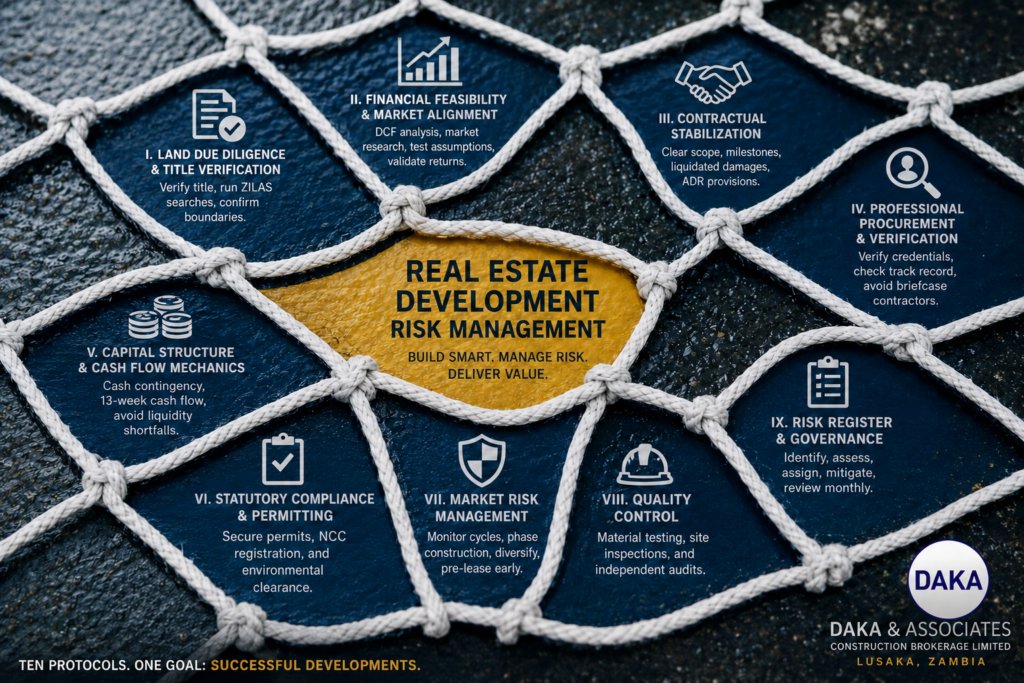
At Daka & Associates, we have distilled the most critical risk protocols into a ten-phase framework. Whether you are developing a residential estate in Lusaka’s expanding corridors or a mixed-use commercial building in a secondary town, these protocols apply. This article walks through every phase in full.
Phase I: Pre-Development Land Due Diligence and Title Verification
The period of highest risk and lowest capital commitment, the most critical window for de-risking.
The pre-development stage is paradoxically the riskiest and the cheapest moment in a project’s lifecycle. At this point, capital commitment is minimal but the decisions made or avoided will determine the project’s legal, financial, and structural trajectory for years. The primary objective is to establish absolute legal, physical, and regulatory clarity regarding the land asset before executing the acquisition.
Legal Title and Ownership Authentication
Establishing a clean legal title is the foundation of real estate risk mitigation. In Zambia, land administration has been modernized through the SMART Zambia Institute and the Ministry of Lands and Natural Resources. While simple register printouts are frequently used for basic checks, judicial precedent is clear: an official search certificate carries substantially greater weight during title disputes.
The process of securing cadastral approval and verifying title is now digitized through the Zambia Integrated Land Administration System (ZILAS), which interfaces directly with the government e-services portal, ZamPortal. This centralized database minimizes the risk of fraudulent land allocations, boundary disputes, and overlapping ownership claims. Regulatory Reference: SI No. 25 of 2024
Under the Lands and Deeds Registry Act, registration fees for State leases, assignments, and transfers are calculated at 1% of the property value, subject to statutory caps. Following the Fees and Fines Regulations under Statutory Instrument No. 25 of 2024 (fee unit value: K0.40), the Kwacha-denominated cost of title transactions is: Minimum: 111 fee units × K0.40 = K44.40 | Maximum: 3,000 fee units × K0.40 = K1,200.00.
Boundary Demarcation and Physical Site Analysis
Boundary verification must rely on empirical data, never visible physical markers. Landowners frequently depend on “fence-line” boundaries that deviate from legal coordinate maps, exposing developers to encroachment lawsuits and court-ordered demolition orders. A registered land surveyor must establish legal coordinate boundaries through cadastral surveys, formally lodged into ZILAS for administrative approval.
Concurrently, physical due diligence requires comprehensive geotechnical and soil examination to identify underlying structural constraints. Certain low-lying zones in Zambia; including the flat, ill-drained areas of Chongwe contain highly swampy soils that require specialized, capital-intensive engineering solutions. Failing to execute a Phase I Environmental Site Assessment (ESA) and geotechnical soil testing before acquisition can lead to foundation settlement, basement flooding, and unforecasted structural remediation costs during excavation.
| Due Diligence Parameter | Regulatory Authority | Fee Structure | Key Risk Mitigated |
|---|---|---|---|
| Title & Deed Ownership | Lands & Deeds Dept. (ZILAS / ZamPortal) | 1% of property value (Min K44.40, Max K1,200) | Fraudulent transactions, ownership disputes, active caveats |
| Boundary Verification | Survey Department (ZILAS Portal) | Variable; private surveyor rates | Encroachment litigation, fence-line boundary errors |
| Soil & Geotechnical Profile | Independent Lab / NCC | Fixed lab testing fees | Structural settlement, swampy soil failures, basement flooding |
Phase II: Quantitative Financial Feasibility and Market Alignment
Your cheapest and earliest form of risk capital before a single Kwacha is committed.
A feasibility study is not an administrative cost or a box-ticking exercise for financiers. It is a vital risk-mitigation tool that establishes a project’s economic viability before committing irreversible capital. Developing a project based on subjective assumptions rather than empirical data is a leading cause of financial failure in Zambia’s real estate sector.
Dynamic Financial Modeling and Cash Flow Forecasting
To secure investment and maintain solvency, developers must construct robust Discounted Cash Flow (DCF) models that evaluate key investment metrics. The two most important are Net Present Value (NPV) and Internal Rate of Return (IRR).
The Net Present Value represents the current estimated value of the project’s projected cash inflows and outflows, adjusted for time and cost of capital:
Net Present Value FormulaNPV = Σ [ CFₜ ÷ (1 + r)ᵗ ]Where CFₜ = Net cash flow during period t | r = Discount rate / required rate of return | t = Number of time periods
A positive NPV indicates the development will yield returns exceeding the cost of capital. A negative NPV indicates the project is financially unfeasible at the assumed discount rate and should not proceed.
The Internal Rate of Return (IRR) is the annualized rate of return at which the NPV of all cash flows equals zero the rate at which the project breaks even on a time-adjusted basis. It is most useful for comparing projects of different sizes or durations.
Internal Rate of Return Formula0 = Σ [ CFₜ ÷ (1 + IRR)ᵗ ]Solve for IRR iteratively. A project’s IRR should exceed the weighted average cost of capital (WACC) to create equity value.
Beyond these baseline metrics, developers must model the “stabilization threshold” the occupancy level (typically 90% or higher) at which net operating income generated by the property covers the development’s ongoing operating expenses and debt service obligations. If this threshold is only reachable under optimistic assumptions, the project carries elevated risk.
| Feasibility Level | Core Objective | Key Inputs Analyzed |
|---|---|---|
| Level 1: Preliminary | Assess high-level project viability | Broad construction costs, target market pricing, gross development margin |
| Level 2: Detailed | Establish formal investment case and bankability | DCF models (NPV, IRR), infrastructure costs, financing rates |
| Level 3: Highest & Best Use | Optimize land utilization and density | Spatial planning limits, zoning restrictions (FAR/BCR), demand shifts |
Localized Market Research vs Regional Metrics
Relying on aggregate national statistics leads to incorrect demand assumptions. Submarket research is essential evaluating localized supply, rental rates, and absorption velocities at the neighborhood level. Developers must also track local construction permit filings to identify competing projects that might launch during their own construction window, which could cause oversupply and depress localized rental rates before the project stabilizes.
Phase III: Contractual Stabilization and Risk Allocation
Vague contracts are a primary catalyst for construction disputes, budget inflation, and schedule slippage.
Contract weakness is one of the most underestimated risks in Zambian real estate development. Developers frequently sign agreements that are long on aspiration and short on specificity creating fertile ground for disputes, inflated variation orders, and prolonged arbitration that bleeds project equity.
Mandatory Structural Elements of Every Construction Agreement
A robust development contract must avoid ambiguity by detailing every financial and operational variable. At minimum, every contract must explicitly cover:
- Definitive Scope of Works: Highly detailed technical documentation specifying every fixture, fitting, material grade, and finish to prevent disputes over base contract inclusions. Ambiguity here is a blank cheque for variation claims.
- Progress Billing and Payment Milestones: Clear disbursement schedules tied directly to verified physical completion milestones on-site not calendar dates. Never pay ahead of physical progress.
- Completion Deadlines and Penalty Frameworks: Realistic construction timelines with clearly defined liquidated damages (LD) to penalize missed deadlines, offsetting the carrying costs of construction loans during delays.
- Quality and Workmanship Standards: Quantitative metrics defining acceptable build quality, backed by independent testing and material certifications not subjective language like “good standard.”
- Change Order Management: A formal, written variation procedure requiring joint sign-offs on costs and schedule impacts before any out-of-scope work is executed. No verbal instructions, no informal WhatsApp approvals.
- Alternative Dispute Resolution (ADR): Structured dispute resolution tiers rapid mediation first, then binding arbitration to keep work moving on-site rather than freezing the project in litigation.
Standardization via FIDIC and Legal Oversight
To minimize contract risk, developers are strongly advised to utilize standardized contract templates such as the FIDIC (International Federation of Consulting Engineers) suite. In large-scale, high-complexity projects, a Turnkey Engineering, Procurement, and Construction (EPC) contract can place performance, timeline, and cost risks with the contractor, shielding the developer from unexpected overruns.
💡 The 10× Legal Investment Rule
Engaging a construction attorney early is a small upfront investment that saves tenfold (10×) the cost in future litigation and delay expenses. Professional legal counsel must review all construction agreements before signing not after a dispute arises.
Phase IV: Professional Procurement and Qualification Verification
The cheapest bid almost always costs the most over the project lifecycle.
A key rule of project de-risking is that selecting professionals solely on price is a false economy. In Zambia’s construction sector, unlicensed, under-capitalized entities regularly secure projects through artificially low bids and then abandon sites mid-build leaving developers with structural failures, legal liability, and lost time. This phenomenon is so common it has a name: “briefcase contractors.”
Professional Board Registration Requirements
The core project team must be comprised of professionals holding active licenses with their respective statutory regulatory bodies. Non-registered professionals expose the developer to professional liability, municipal submission rejections, and insurance invalidation:
| Professional | Licensing Body | Statutory Act | Critical Project Function |
|---|---|---|---|
| Architect | ZIA / Registration Board | Architects Act | Spatial design, municipal submissions, aesthetic approval |
| Structural / Civil Engineer | Engineering Institution of Zambia (EIZ) | Engineering Profession Act | Foundation calculation, load-bearing design, structural certification |
| Quantity Surveyor | SIZ / QS Registration Board | Quantity Surveyors Act (Cap 438) | Accurate cost estimation, BOQ preparation, payment valuation |
| Contractor | National Council for Construction (NCC) | NCC Act No. 10 of 2020 | Physical execution, labor coordination, structural safety |
Vetting Contractors: A Four-Step Protocol
Beyond license verification, developers must implement a structured contractor vetting process before appointment:
- Verify NCC Licensing and Grading: Confirm the contractor holds active registration with the National Council for Construction (NCC), which maintains a gazetted list of registered contractors categorized from Grades 1 to 6 by project value and technical capacity.
- Conduct Physical Inspections: Visually inspect the contractor’s last two to three completed projects to evaluate construction standards, finish quality, and workmanship not just their portfolio photographs.
- Perform Reference Checks: Contact past clients directly to confirm the contractor’s adherence to schedules, handling of variation orders, attitude toward defects liability, and overall professionalism under pressure.
- Assess Financial Health: Verify the contractor’s balance sheet, banking relationships, and credit lines to ensure they have the financial capability to fund material purchases and labor payroll before progress payments are disbursed. A contractor who cannot fund Week 1 without your advance is a project-stopping liability.
Phase V: Capital Structure Optimization and Cash Flow Mechanics
Running out of cash mid-build is a leading cause of project failure leaving deteriorating half-built structures and demanding banks.
Cash flow failure is the most common reason viable projects collapse in Zambia’s real estate sector. A project can have sound architecture, clean title, and strong market demand, and still fail catastrophically if the developer runs out of working capital at 60% or 70% completion. The result is a deteriorating half-built structure, a construction loan in default, and years of costly recovery.
Capital Stack and Debt Management
Developers must optimize their capital stack the balance of equity, senior debt, and mezzanine financing to support construction without creating excessive debt-service pressure. Project sponsors typically contribute 5% to 20% of total capital as equity, raising the remaining balance from institutional investors and financial institutions.
While high leverage can amplify returns in strong markets, it accelerates insolvency risk if absorption rates slow. Developers must continuously monitor two critical ratios:
- Loan-to-Value (LTV) Ratio: The proportion of the project’s appraised value that is financed by debt. Conservative LTV ratios particularly below 65–70% provide a cushion against value corrections.
- Debt Service Coverage Ratio (DSCR): The ratio of net operating income to debt service obligations. A DSCR below 1.0 means the project cannot service its debt from operations a distress signal requiring immediate intervention.
Four Non-Negotiable Cash Flow Rules
- Establish a Rigid Cash Contingency: Maintain a dedicated 10–20% cash contingency reserve, held separately from the baseline construction budget, to absorb unexpected material price increases, delays, or structural issues. This is not optional it is the project’s insurance policy.
- Secure Financing Before Breaking Ground: Never commence physical works based on verbal agreements or anticipated future equity injections. All financing facilities must be fully underwritten, closed, and drawn before site mobilization begins.
- Implement Rolling 13-Week Cash Forecasts: Re-project cash receipts, material supplier payments, and subcontractor drawdowns weekly not monthly to identify potential liquidity shortfalls before they delay construction.
- Reject Speculative Funding Models: Do not rely on “sell-as-we-build” financing schemes that depend on continuous pre-sales velocity to fund basic construction. If pre-sales slow which they will at some point construction halts.
Specialized Accounting Standards Compliance
Corporate real estate projects require specialized accounting practices to maintain compliance and preserve investor trust. Three key standards govern how development costs and revenues are recorded:
- ASC 606 (Revenue Recognition): Controls whether revenue from pre-sales or multi-phase developments is recognized over time or at a single point upon delivery, depending on when control of the asset transfers to the buyer.
- ASC 835-20 (Interest Capitalization): Mandates that interest expenses incurred during the active development period must be capitalized into the asset cost not expensed immediately directly impacting the project’s balance sheet.
- IRS Section 263A (Capitalization of Costs): Dictates which overhead, planning, and construction expenses must be capitalized as part of the real estate asset cost, requiring systematic job-costing processes.
Phase VI: Statutory Compliance and Permitting Frameworks
Cut corners on statutory compliance and regulators will shut down construction at your cost.
Navigating municipal planning, building codes, environmental regulations, and labor laws is not optional. Regulatory non-compliance can trigger stop-work orders, demolition notices, and substantial fines all at the developer’s expense, and all while the construction loan continues accruing interest.
Municipal Approvals: The LCC Three-Stage Process
Developers must coordinate closely with the Lusaka City Council (LCC) Planning Department and equivalent bodies in other municipalities. The building permit process has three sequential stages, each with its own timeline:
- Architectural Submission (≈30 days): The registered architect uploads drawings, survey plans, and rates clearance receipts to the LCC portal. The council issues an approval notification after a minimum of 30 days of review.
- Structural Engineering Submission (≈30 days): A registered structural engineer prepares and uploads structural drawings and a certificate of structural design. Sign-off takes approximately 30 additional days.
- NCC Project Registration (30 working days, K400): The project must be registered with the National Council for Construction at a flat cost of K400. A 30-working-day processing period must elapse before construction can legally commence.
⚠ Critical Timeline Warning
The combined LCC and NCC approval process takes a minimum of 90 calendar days under optimal conditions. Developers who do not initiate this process immediately after land acquisition frequently find their construction window delayed by three to four months with loan interest continuing to accumulate.
Environmental Impact Assessment: The 2026 Reform
Environmental clearance is a mandatory prerequisite for development in Zambia. The regulatory landscape underwent a major shift with the gazetting of Statutory Instrument No. 3 of 2026 (the Environmental Management [Environmental Impact Assessment] Regulations, 2026), which took effect on 9 January 2026. This framework overhauled project classifications, enforced mandatory registration of EIA experts with the Zambia Environmental Management Agency (ZEMA), and substantially reduced both fees and review timelines to accelerate private investment.
| Assessment Tier | Previous Fee | Revised Fee (SI 3/2026) | Previous Timeline | Revised Timeline |
|---|---|---|---|---|
| Environmental & Social Project Brief (ESPB) | K17,300 | K5,300 | 45 working days | 20 calendar days |
| Environmental & Social Impact Statement (ESIS) | K1,300,000 | K600,000 | 60 working days | 30 calendar days |
All assessments must be signed off by a ZEMA-registered expert. Any material change in project scope or design requires immediate notification to ZEMA for potential supplementary reviews.
Labor, Social Security, and Insurance Mandates
Every construction site in Zambia must maintain four core insurance coverages, and developers are legally responsible for verifying that contractors carry all of them:
- Contractor’s All Risk (CAR) Insurance: Covers physical damage to the property, materials, and machinery during the construction phase.
- Public Liability Insurance: Protects against third-party injury or property damage claims occurring on or around the job site.
- Professional Indemnity Insurance: Covers financial losses resulting from design errors or omissions by architects, engineers, or quantity surveyors.
- Workers’ Compensation: Under the Workers Compensation Act No. 10 of 1999, private and public sector employers must register with the Workers Compensation Fund Control Board (WCFCB) and pay statutory assessments. The fund provides medical care, pension, and survivor compensation for workplace injuries.
Developers must also ensure all contributions are paid to the National Pension Scheme Authority (NAPSA). Failure to comply exposes the developer to substantial audits, fines, and worker claims that survive well beyond project completion.
Phase VII: Strategic Market Risk Management and Absorption Protection
Real estate markets are cyclical delivering into a down market can erase returns unless structural protections are built in.
Even a technically well-executed project can destroy equity if it is delivered into a soft market. Zambia’s real estate cycles are influenced by macroeconomic factors exchange rate volatility, credit availability, government capital expenditure that can shift significantly over a 24 to 36 month construction window. Developers must build market cycle protection into the project structure, not treat it as a post-launch problem.
Three Structural Market Risk Strategies
- Mixed-Use Asset Allocation: Diversifying across different property types such as combining residential apartments with ground-floor retail and commercial office spaces insulates the project from a downturn in any single sector. If residential absorption softens, retail income can sustain debt service.
- Phased Construction: Rather than constructing an entire project simultaneously, break it into sequential phases. This allows developers to adjust the timing and specification of later phases based on real-time market absorption rates avoiding the risk of delivering 300 units into a market that can absorb 80.
- Targeted Pre-Leasing and Pre-Sales: Securing anchor tenants or pre-construction sales commitments before completing construction validates market demand and provides cash flow certainty, materially improving the project’s bankability and reducing marketing-phase risk.
“Developers must protect themselves against shifting demand and falling prices. Delivering a project into a down market can erode returns unless protection strategies are integrated into project planning not retrofitted after the fact.”
Phase VIII: Quality Control and Quality Assurance Systems
“Test, don’t guess.” Subpar construction standards lead to structural failures, litigation, and reputational collapse.
Quality failures in construction are rarely dramatic single events. They accumulate gradually a substandard concrete mix here, a covered-over crack there until the cumulative defects manifest as a structural failure, a legal claim, or a building that cannot be certified for occupation. Developers who delegate quality entirely to contractors without independent verification are accepting a risk they have no visibility over.
Material Verification and Independent Inspections
- Raw Material Verification: Establish strict physical testing for all primary building materials. The NCC operates a specialized Construction Material Testing Laboratory that developers can engage to verify concrete compressive strength, steel tensile strength, and other structural parameters before materials are incorporated into the works.
- Continuous Progress Monitoring: Conduct weekly site inspections to evaluate progress, safety compliance, and build quality. Small errors caught before they are covered by subsequent works cost a fraction of the price of post-completion remediation. The 5× remediation rule applies in full here.
- Independent Third-Party Audits: Retain independent clerks of works or third-party structural inspectors who have no financial interest in the contractor’s performance. An inspector on the contractor’s payroll or one who knows their continued engagement depends on smooth sign-off will not catch problems the contractor wants hidden.
Phase IX: The Comprehensive Project Risk Management Plan
Developers cannot eliminate all risks but they can manage them through a formal, active, and monthly-reviewed Risk Register.
A risk management plan is not a document produced once at project initiation and filed away. It is a living instrument that evolves as the project progresses, market conditions shift, and regulatory landscapes change. Every project-level threat must be assigned a named owner and a specific mitigation action not a general responsibility.
Structure of the Active Risk Register
Below is the core structure of a project risk register, illustrating the categories, owners, and mitigation actions required for a Zambian capital real estate project:
Risk Category
Financial Risk
>Interest rate hikes on construction loans
>Probability / Impact
>High Prob Moderate Impact
>Active Mitigation
>Maintain conservative LTV ratios; utilize fixed-rate financing; maintain 10–20% contingency. Owner: CFO
Market Risk
>Oversupply and slow tenant absorption
>Probability / Impact
>Moderate Prob High Impact
>Active Mitigation
>Implement phased building; diversify property types; secure pre-sales / pre-leases. Owner: Head of Development
Regulatory Risk
>Delays in municipal planning approvals
>Probability / Impact
>High Prob Moderate Impact
>Active Mitigation
>Build realistic buffer times into the master schedule; verify zoning with LCC early. Owner: Project Manager / Architect
Environmental Risk
>Unexpected soil issues or contamination
>Probability / Impact
>Low Prob High Impact
>Active Mitigation
>Execute Phase I ESAs and comprehensive soil testing before acquisition. Owner: Geotechnical Engineer
Construction Risk
>Contractor delays or budget overruns
>Probability / Impact
>High Prob High Impact
>Active Mitigation
>Use fixed-price FIDIC contracts; verify contractor capacity; require performance bonds. Owner: QS
Labor & Compliance
>WCFCB or NAPSA audit failures
>Probability / Impact
>Low Prob High Impact
>Active Mitigation
>Mandate proof of monthly statutory contributions from all subcontractors. Owner: HR Manager
The risk register must be reviewed and updated monthly to reflect evolving market, regulatory, and construction conditions. A risk register that is accurate at month one and ignored thereafter is a false comfort.
Phase X: Conclusions and Five Actionable Recommendations
Successful developers do not rely on market luck they manage risk through pre-development planning, verified professionals, and cash-flow discipline.
Commercial real estate development is a complex, high-risk process where execution errors can quickly erode profit margins. De-risking a project requires a disciplined approach that balances market demand, financial modeling, and strict construction oversight. The 5× remediation rule governs throughout: every problem caught in planning costs a fraction of the same problem discovered after concrete is poured.
“Successful developers do not rely on market luck. They manage risk through careful pre-development planning, the appointment of qualified professionals, and the maintenance of strict cash-flow discipline from acquisition to handover.”
Five Core Protocols to Protect Equity
Establish Weekly Site Oversight: Track budget, schedule, and safety compliance weekly. Correct a defect during planning. Catching a structural issue after concrete has been poured costs at least 5× more in direct remediation and that excludes delay costs, loan interest, and legal exposure.
Execute Rigorous Pre-Acquisition Due Diligence: Never acquire land based on verbal assurances. Confirm clean legal title through ZILAS official searches. Complete detailed geotechnical soil testing before closing the transaction. The pre-acquisition phase is the cheapest moment to identify a fatal flaw.
Maintain Cash Flow Discipline: Never break ground without fully closed financing and a liquid cash contingency of 10–20%. Run weekly 13-week rolling cash flow forecasts. Avoid speculative pre-sales-only funding models that chain your construction program to buyer velocity.
Appoint Verified Professionals Only: Ensure all design and construction team members hold valid registrations with their respective statutory bodies ZIA, EIZ, SIZ, and NCC. Protect the project from briefcase contractors through independent licensing verification, physical site inspections, and reference checks.
Utilize Standardized Contracts: Use clear, standardized contract templates such as the FIDIC suite to establish balanced risk-sharing, scope parameters, and dispute resolution paths. Have all agreements reviewed by construction legal counsel before signing not during a dispute.