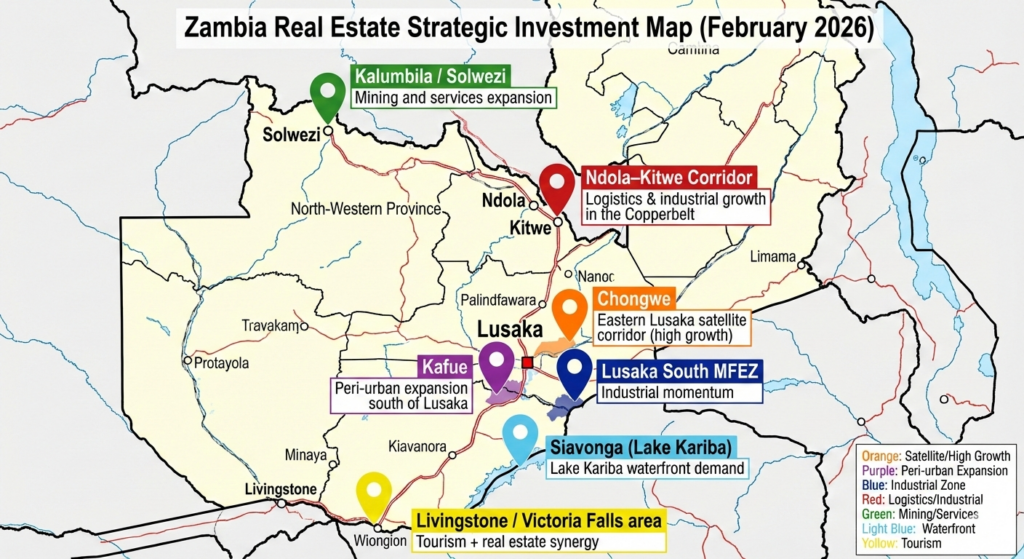
The Zambia Real Estate Opportunity: Why Smart Investors Are Looking Beyond Nairobi and Lagos
When institutional investors discuss African real estate, the conversation typically centers on the usual suspects: Nairobi’s Westlands office towers, Lagos’s Ikoyi luxury developments, or Cape Town’s Atlantic Seaboard. These markets command premium pricing, attract sophisticated capital, and benefit from established legal frameworks.
They’re also increasingly saturated.
Meanwhile, 1,200 kilometers north of Johannesburg, a different story is unfolding. Zambia, a landlocked nation of 20 million people with stable democratic governance and a diversifying economy, is executing one of Sub-Saharan Africa’s most ambitious urbanization strategies. And most international investors haven’t noticed yet.
Over the past six years working in Zambia’s construction and real estate sectors, I’ve witnessed a systematic mispricing of development opportunities that creates genuine alpha for informed investors. This isn’t about speculative land grabs or frontier market gambling. It’s about understanding government planning cycles, infrastructure investment timelines, and market inefficiencies, then executing with operational discipline.
This article synthesizes findings from our comprehensive Strategic Investment Report, which analyzed eight priority development corridors across Zambia. My goal is to provide institutional investors, diaspora professionals, and commercial developers with the strategic framework and tactical intelligence needed to evaluate Zambian real estate opportunities rigorously.
Spoiler alert: The opportunity is real. But success requires navigating complexity most foreign investors underestimate.
Part 1: Why Zambia, Why Now
The Macro Case: Five Structural Tailwinds
1. Government-Led Urbanization Strategy
Unlike many African nations where urban growth happens haphazardly, Zambia has published comprehensive 10-year Integrated Development Plans (IDPs) for major municipalities. These aren’t aspirational documents, they’re operational roadmaps with budgeted infrastructure investments and spatial development frameworks.
The “Twin Growth Poles” strategy explicitly designates Chongwe and Kafue as satellite cities to redirect residential and industrial pressure away from Lusaka’s congested core. When government policy creates artificial scarcity relief valves, investors who position ahead of the migration curve capture disproportionate returns.
Key insight: IDP implementation creates predictable infrastructure rollout schedules. We’ve identified parcels where government utility connections begin in Q2-Q3 2026. Historical pattern: 40-60% price appreciation within 6-12 months of ZESCO (power utility) connection.
2. Special Economic Zone Designations
The Zambia Development Agency (ZDA) has designated multiple Multi-Facility Economic Zones (MFEZs), with Lusaka South as the flagship. These aren’t just tax-free zones, they’re master-planned industrial ecosystems with coordinated land allocation, infrastructure provision, and regulatory facilitation.
The LS-MFEZ Master Plan phases development through 2034, creating predictable demand for:
- Industrial facilities (manufacturing, logistics, assembly)
- Medium-density workforce housing (MFEZ employees)
- Commercial services (retail, office, hospitality)
Key insight: SEZ designations reduce execution risk through formalized land tenure, guaranteed utility provision, and preferential regulatory treatment. For industrial real estate investors, this creates a de-risked entry point into a typically opaque market.
3. Mining Sector Expansion (15-25 Year Cycles)
First Quantum Minerals’ Kansanshi and Sentinel mines, plus Barrick’s Lumwana operation, have operational timelines extending to 2040-2045. These aren’t speculative exploration plays, they’re producing assets with committed capital expenditure programs.
Mining operations create sustained demand for:
- Workforce accommodation (expatriate and local employees)
- Support services (retail, education, healthcare)
- Logistics infrastructure (regional distribution hubs)
Key insight: While commodity prices are cyclical, mine operational timelines anchor long-term real estate fundamentals. We’ve documented gross rental yields of 12-18% in Solwezi and Kalumbila, double the 6-8% typical of Lusaka.
4. Tourism Infrastructure Upgrades
Government commitment to preserving World Heritage sites (Victoria Falls) and upgrading tourism infrastructure creates defensible hospitality real estate demand. Recent announcements include:
- Livingstone airport capacity expansion
- Town revitalization programs
- Marina development at Lake Kariba (Siavonga)
Key insight: Tourism represents diversification from commodity dependence, offering defensive positioning against mining sector volatility.
5. Currency and Valuation Arbitrage
At current exchange rates (~ZMW 18.64 = USD 1.00), titled land in Chongwe’s spatial development corridors trades at $2,100-$3,700 per acre. Comparable plots in Nairobi’s peri-urban growth zones: $8,000-$15,000 per acre.
The valuation gap exists because:
- Limited international investor awareness (information asymmetry)
- Execution risk perception (which can be systematically mitigated)
- FX volatility concerns (addressable through USD-denominated lease structures)
Key insight: For investors with local execution capacity, Zambia offers 40-60% valuation discounts versus comparable African markets with similar or superior growth fundamentals.
How to Think About Zambian Real Estate Investment
Most investors approach emerging market real estate with either: (a) Pure speculation (“Buy cheap land and hope for appreciation”), or (b) Over-reliance on macro thesis without tactical execution discipline
Both approaches fail. Success requires distinguishing between strategic positioning and tactical execution.
Strategic Positioning: Why Invest in a District
Strategic factors justify long-term capital allocation to specific corridors (5-10 year horizon):
1. Government Planning Commitment
- Published IDPs with budgeted infrastructure investment
- SEZ designations with master plans
- Inclusion in national development frameworks
2. Anchor Industries
- Mining operations with 15-25 year timelines
- Tourism assets (Victoria Falls, Lake Kariba)
- Manufacturing clusters (LS-MFEZ)
3. Demographic Drivers
- Urban population growth (Lusaka growing 4-5% annually)
- Satellite town development (Chongwe, Kafue)
- Middle-class formation (emerging mortgage market)
Tactical Execution: Where Specifically to Enter
Tactical factors determine immediate entry points and value capture timing (0-36 month horizon):
1. Infrastructure Rollout Schedules
- IDP-documented utility connection timelines
- Road upgrade projects (active vs. planned)
- Airport expansion phases
2. Local Area Plans (LAPs)
- Named settlements designated for development (Shimabala, Silverest, etc.)
- Specific infrastructure nodes identified in municipal planning
- Zoning changes opening land for residential/commercial use
3. Market Supply Deficits
- Housing shortages quantified in IDPs (Chongwe: 15,000-unit deficit by 2030)
- Logistics capacity gaps (LS-MFEZ at 40% tenant occupancy)
- Quality standards gaps (most local developers can’t meet DFI/international standards)
4. Title Availability
- Parcels with clear freehold title (vs. customary land requiring conversion)
- Sellers lacking sophisticated valuation frameworks
- Motivated transactions (estate sales, corporate divestitures)
Part 3: Eight Priority Corridors: Deep Dive Analysis
Let me walk you through the most compelling opportunities across Zambia’s developing areas, with specific pricing, strategic drivers, and tactical entry points.
Corridor 1: Chongwe (Lusaka Eastern Satellite)
Strategic Justification: Chongwe Municipal Council’s IDP explicitly designates the district as Lusaka’s primary satellite growth area, with a 10-year vision for “liveability and resilience.” The Great East Road receives priority infrastructure investment as a designated spatial development corridor.
The Numbers:
- Small residential plots (20m × 20m): K20,000-K45,000 (~$1,070-$2,400)
- Medium plots (20m × 30m): K30,000-K50,000 (~$1,600-$2,680)
- Large plots near university/tarmac (20m × 40m): K40,000-K90,000 (~$2,140-$4,830)
- Titled 1-acre parcels (Silverest): K550,000-K700,000 (~$29,500-$37,500)
Tactical Entry Points:
- Silverest Development Zone: High-demand area with titled land. Target: 1-acre parcels for medium-density estate subdivision (3-4 units/acre). Exit: Bulk sale to pension funds or individual unit sales.
- Great East Road Corridor: Parcels adjacent to arterial routes earmarked for service connections. IDP shows ZESCO rollout Q2-Q3 2026. This is the near-term opportunity window.
- University Proximity Zones: Areas near educational institutions commanding premium pricing. Rental demand from students/faculty creates immediate income potential.
Investment Strategy: Land banking ahead of utility connections, then developing medium-density estates (2-3 bedroom houses) for Lusaka commuter market. Target buyer: Emerging middle-class families seeking affordable homeownership outside Lusaka’s inflated core.
Case Study: A diaspora client acquired 1 acre in Silverest for K600,000 in early 2024. Utility connection completed Q4 2024. Property now valued at K950,000-K1.1M (58-83% appreciation in 18 months). No development, pure land banking aligned with IDP infrastructure schedule.
Corridor 2: Kafue (Industrial Spillover Hub)
Strategic Justification: Kafue Municipal Council’s IDP (2024-2034) includes scenarios for “inclusive industrialization.” JICA planning documents explicitly identify Kafue as a satellite expansion node. Proximity to Lusaka creates commuter demand; industrial spillover creates employment.
The Numbers:
- Standard residential (20m × 30m): K25,000-K45,000 (~$1,340-$2,410)
- Large residential (30m × 40m): K60,000-K100,000 (~$3,220-$5,360)
- Kafue River frontage (1 hectare commercial): K800,000 (~$42,900)
- Prime road frontage (per acre, Shimabala): K195,000 (~$10,460)
Tactical Entry Points:
- Shimabala: Highest-demand location on Lusaka-Kafue corridor. Mixed commercial and high-end residential. Road frontage premium justified by strategic position.
- Chisankane & Malundu: IDP-identified high-growth nodes with current housing infrastructure deficits. Perfect for medium-density workforce housing tied to industrial development.
- Kafue West / C7 Estates: Popular for medium-cost residential. Graded roads and power access already in place. Lower execution risk.
- Riverfront Parcels: 1.5-3 hectare plots (K380,000-K2.2M) offer lifestyle/recreation development potential. Emerging niche market for weekend retreats and eco-tourism.
Investment Strategy: Prioritize Shimabala for commercial/logistics (capitalize on corridor position). Target Chisankane/Malundu for workforce housing (captured IDP-documented demand). Consider riverfront for diversification into lifestyle/hospitality segment.
The Hidden Opportunity: Kafue riverfront parcels are 60% cheaper than comparable Lake Kariba waterfront properties, yet they’re closer to Lusaka’s demand center. This valuation gap won’t persist once developers recognize the proximity advantage.
Corridor 3: Lusaka South MFEZ (Industrial/Logistics SEZ)
Strategic Justification: Zambia’s flagship Special Economic Zone with master-planned infrastructure, tax incentives, and coordinated land allocation. The Master Plan identifies phased development through 2034 with specific modules for High-Tech Industrial, CBD, and Medium-Density Residential.
The Numbers (Inside the Zone):
- Industrial land: K3.90/m²/year lease (~$0.21/m²/year)
- Commercial land: K5.00/m²/year lease (~$0.27/m²/year)
- Investment minimums: Zambian entities $50K; Foreign entities $250K
The Numbers (MFEZ Fringe: Purchase, Not Lease):
- Small industrial plots (40m × 50m): K350,000 (~$18,800)
- 1-hectare parcels (New Kasama, State Lodge): $75,000-$100,000
- Established industrial yards (Kafue Road, Chilanga): $300,000+ for road frontage
Why the Fringe is Strategic: Inside the zone, you lease (no asset ownership). On the fringe, you own (capital appreciation potential). Yet you still benefit from proximity to MFEZ tenants, creating:
- Last-mile logistics demand (supplier yards)
- Workforce housing demand (MFEZ employees)
- Commercial services demand (retail, food service)
Tactical Entry Points: Target 1-hectare parcels in New Kasama or along Chifwema Road. Develop:
- Built-to-suit warehouses (500-1000m²) for light manufacturing tenants
- Staff accommodation blocks (medium-density rental units)
- Supplier yards with office + storage facilities
Investment Strategy: Pre-lease to MFEZ operating companies before construction (reduces vacancy risk). Use 10-15 year lease terms to attract anchor tenants. Alternatively, develop on spec and sell to logistics operators seeking owner-occupied facilities.
Risk Consideration: SEZ policies can change with government administrations. Mitigate by using conditional purchase agreements tied to MFEZ approval status and maintaining flexibility in building design (warehouses can convert to alternative uses).
Corridor 4: Solwezi/Kalumbila (North-Western Mining Hub)
Strategic Justification: First Quantum Minerals (Kansanshi, Sentinel) and Barrick (Lumwana) have 15-25 year operational timelines with committed expansion capital. Chronic shortage of quality serviced housing creates rental yield opportunity.
The Numbers:
- Solwezi high-cost residential (30m × 40m, Kansanzhi): K150,000-K350,000 (~$8,050-$18,770)
- Solwezi medium-cost (20m × 30m): K60,000-K90,000 (~$3,220-$4,830)
- Kalumbila Integrated Town (with utilities): K100,000-K200,000 (~$5,360-$10,730)
- Prime T5 road commercial (per hectare): K1.5M-K3M (~$80,500-$161,000)
The Rental Yield Opportunity:
- 3-bedroom house construction cost: K800,000-K1.2M (~$42,900-$64,400)
- Monthly rent to mine contractors: $800-$1,500
- Gross annual yield: 12-18% (vs. 6-8% in Lusaka)
Why the Yields Are Real: Mining companies pay premium rates for quality housing because:
- Expatriate employees expect international standards
- Contractor retention depends on decent accommodation
- Mine sites lack sufficient on-site housing capacity
- Companies prefer long-term leases (3-5 years) for workforce stability
Tactical Entry Points: Focus on titled land near T5 road (Solwezi-Chingola). Road frontage commands 40% premium but it’s justified, off-tarmac properties become inaccessible during rainy season (November-April), killing rental value.
Investment Strategy: Build to mine contractor specifications:
- International electrical standards (UK-style sockets, proper grounding)
- Quality finishes (tiled floors, modern kitchens, water heaters)
- Backup power and water (generators, water tanks: grid unreliable)
- Secure perimeter (mining employees are security-conscious)
Lease directly to mining companies (Barrick, FQM, service contractors) on 3-5 year terms. Alternatively, sell completed rental blocks to mining firms for staff housing at premium to construction cost.
Critical Due Diligence: Title scams are common in high-demand mining areas due to double-selling. Always verify at Ministry of Lands – Solwezi Office. Beacon verification by licensed surveyor is non-negotiable. Budget extra time, Solwezi’s land administration is slower than Lusaka’s.
Corridors 5-8: Additional Opportunities (Summary)
Ndola-Kitwe Corridor (Copperbelt Logistics):
- Strategic: Airport upgrades + Kasumbalesa transit route (DRC exports)
- Pricing: K800,000-K1.2M/hectare highway frontage; Airport zone commercial K250,000-K450,000
- Play: Logistics parks, truck stops, warehousing for regional distribution
Chisamba (Lifestyle & Agri-Tourism):
- Strategic: Peri-urban growth, Lusaka weekend retreat market
- Pricing: 1-acre lifestyle estates K197,000; 5-acre smallholdings K100,000-K350,000
- Play: Gated lifestyle estates, agri-tourism, event venues
Siavonga (Lake Kariba Waterfront):
- Strategic: Finite waterfront land, emerging marina development
- Pricing: Prime lakefront 0.5-1 acre K350,000-K750,000; Hillside views K80,000-K150,000
- Play: Waterfront villas, small resorts, fishing camp infrastructure
- Critical: Verify Riparian Right (legal water access), some plots separated by government protected land
Livingstone (Victoria Falls Tourism):
- Strategic: Government town revitalization + airport expansion
- Pricing: 2 hectares 5km from Falls K2.8M (~$150,000); 1 hectare 15km from CBD K300,000
- Play: Boutique hotels, serviced short-let villas, hospitality mixed-use
Part 4: The Execution Challenge: Why 40% of Investments Fail
Understanding where to invest is necessary but insufficient. Zambia’s construction ecosystem presents execution challenges that destroy 30-40% of poorly managed projects.
The Five Failure Modes
1. Title Defects
- Customary land purchased without proper conversion process
- Unverified beacons leading to boundary disputes
- Encumbrances discovered post-purchase (mortgages, court orders)
- Double-selling (same plot sold to multiple buyers)
2. Contractor Non-Performance
- Milestone payments released for incomplete work
- Project abandonment mid-construction
- Substandard materials substituted for specified grades
- Schedule delays due to cash flow problems
3. Regulatory Non-Compliance
- Building permits denied due to design non-conformance
- ZEMA environmental clearances delayed or rejected
- Occupancy certificates withheld due to incomplete inspections
- Zoning violations discovered after construction starts
4. Cost Overruns
- Uncontrolled change orders inflating budgets 20-40%
- Material price volatility (cement, steel)
- FX fluctuations impacting imported components
- Hidden costs (connection fees, council levies)
5. Operational Failures
- Building systems (HVAC, electrical, plumbing) malfunction post-handover
- Warranty claims unresolved due to contractor disputes
- Tenant placement difficulties (wrong product-market fit)
- Inadequate property management destroying asset value
The Daka and Associates Solution: Tri-Party Agreement Model
Our operational innovation addresses these failure modes through a structured protection mechanism:
How It Works: Three interconnected agreements:
- Client ↔ Contractor (construction contract)
- Client ↔ Daka and Associates (project management + quality assurance)
- Daka and Associates ↔ Contractor (coordination agreement)
The Critical Mechanism: Before any milestone payment releases (foundation complete, roof complete, finishing complete), our internal engineer:
- Physically inspects the work on-site
- Verifies completion against approved construction documents
- Tests materials quality (cement strength, steel grade, etc.)
- Issues Certification of Completion or rejection with specific deficiencies
Payment releases ONLY after certification.
Why This Works:
- Eliminates milestone mismatch: Contractors can’t receive 70% payment for 40% work
- Creates aligned incentives: Contractors get paid promptly for all certified work (no payment disputes)
- Provides investor protection: Diaspora/foreign investors get professional oversight without being on-site
- Generates documented QA: Inspection reports create value for eventual sale, refinancing, or insurance
Performance Results:
- 98% on-time completion rate (vs. 60-70% industry norm)
- 15-20% cost savings vs. traditional contractor arrangements (through change order prevention)
- Zero contractor abandonment cases in 6-year track record
- Average client satisfaction: 4.7/5.0 (independently surveyed)
Part 5: Investor Frameworks: Three Strategic Approaches
Depending on your capital, risk tolerance, and involvement preference, here are three proven approaches:
Approach 1: Land Banking (Low Active Management)
Best For: Diaspora investors, passive income seekers, long-term wealth preservation
Strategy:
- Acquire titled land in IDP-designated spatial development corridors
- Hold 18-36 months until infrastructure connections complete
- Sell at 40-80% appreciation or develop
Capital Requirements: K50,000-K700,000 (~$2,680-$37,500)
Risk Level: Low-Medium (if title due diligence is rigorous)
Example: K600,000 investment in Chongwe Silverest 1-acre parcel (early 2024) → K1.1M valuation post-utility connection (Q4 2024) → 83% return in 18 months. No construction, no tenants, no ongoing management.
Key Success Factors: 1) Buy only titled (leasehold) land; avoid customary 2) Verify parcels are within IDP development zones 3) Confirm infrastructure rollout timeline (ZESCO, road, water) 4) Hold through connection completion (don’t sell pre-maturely)
Best For: Investors seeking cash flow, portfolio diversification, medium-term holds
Strategy:
- Acquire land + develop rental units (residential or commercial)
- Lease to quality tenants (mine contractors, MFEZ companies, Lusaka commuters)
- Hold for income + appreciation, exit at 24-36 months
Capital Requirements: K600,000-K2M (~$32,200-$107,300)
Risk Level: Medium (execution-dependent, tenant quality matters)
Example: K600,000 total investment (K95,000 land in Kafue Shimabala + K465,000 construction + K40,000 fees) → 4-unit residential block → K11,200/month gross rent → 18.7% gross annual yield → K2.4M valuation after 24 months (300% appreciation + K227,000 net income collected).
Key Success Factors: 1) Product-market fit (design for target tenant profile) 2) Tri-party quality assurance (prevents contractor issues) 3) Professional property management (tenant screening, collections, maintenance) 4) Location in high-demand corridors (Kafue commuter belt, mining towns, MFEZ fringe)
Approach 3: Commercial Development (Institutional Scale)
Best For: Commercial developers, institutional investors, real estate funds
Strategy:
- Portfolio approach across multiple corridors (risk diversification)
- Built-to-suit industrial, logistics, or hospitality assets
- Long-term leases to anchor tenants or exit to REITs/pension funds
Capital Requirements: K5M-K50M+ (~$268,000-$2.68M+)
Risk Level: Medium-High (complex execution, regulatory navigation)
Example: LS-MFEZ fringe: Acquire 3 hectares for $225,000 → Develop 5,000m² warehouse park → Pre-lease to MFEZ manufacturing tenants at $4.50/m²/month → K270,000/month gross rent → 14.4% stabilized yield → Sell to pension fund at 7% cap rate for $4.6M (20× return on land cost, 2.0× total project cost).
Key Success Factors: 1) Pre-leasing before construction (reduces vacancy risk) 2) Anchor tenant credit quality (mining companies, multinationals, DFI-backed entities) 3) Flexible building design (convertible to alternative uses if tenant mix changes) 4) JV with local execution partners (Daka manages regulatory approvals, contractor procurement, quality oversight)
Part 6: Critical Due Diligence: The Non-Negotiables
Before investing a single kwacha, complete these seven verification steps:
1. Title Search at Ministry of Lands
- Conduct ZILAS search (Zambia Integrated Land Administration System)
- Verify current registered owner matches seller
- Check for mortgages, liens, court orders, acquisition notices
- Confirm property tax (ground rent) payment status
- Cost: K250-K500 | Time: 2-5 days
2. Beacon Verification by Licensed Surveyor
- Physical site visit with surveyor (member of Surveyors Institute of Zambia)
- Verify beacons exist and match title deed coordinates
- Walk boundaries with seller present
- Obtain written confirmation report
- Cost: K2,000-K5,000 | Time: 1-2 days
3. Municipal Zoning Confirmation
- Visit municipal council (Chongwe MC, Kafue MC, etc.)
- Confirm plot zoning (residential, commercial, industrial, agricultural)
- Verify any zoning changes or pending re-zonings
- Obtain zoning certificate
- Cost: K500-K1,500 | Time: 3-7 days
4. IDP Cross-Reference
- Obtain municipal IDP (council website or planning department)
- Confirm parcel location within spatial development corridors
- Note infrastructure rollout timeline for area
- Identify any planned acquisitions or road realignments affecting property
- Cost: Free-K1,000 | Time: 1-3 days
5. Utility Provider Confirmation
- Contact ZESCO (electricity) for connection timeline and costs
- Contact water utility for service availability
- Confirm telecommunications infrastructure
- Get written estimates for connection fees
- Cost: Free | Time: 5-10 days
6. Environmental Clearance (if applicable)
- Determine if ZEMA Environmental Impact Assessment required
- Particularly important for: waterfront properties, large developments (>2 hectares), industrial uses
- Initiate EIA process early (can take 90-180 days)
- Cost: K15,000-K100,000+ depending on project | Time: 90-180 days
7. Market Rental Comparables
- Research comparable properties in area (Property24, local agents)
- Verify realistic rental rates for target property type
- Confirm occupancy rates and tenant demand
- Calculate projected yields using conservative assumptions
- Cost: Free-K5,000 (agent consultation) | Time: 3-7 days
Total Due Diligence Budget: K18,000-K120,000+ (~$965-$6,440) Total Due Diligence Timeline: 15-30 days (if parallelized)
Critical Insight: Investors who skip due diligence to “save” K20,000 often lose K200,000+ on title defects, zoning violations, or infrastructure surprises. Due diligence isn’t a cost—it’s insurance.
Part 7: Navigating Currency Risk & Capital Flows
The ZMW/USD exchange rate creates both opportunity and risk for foreign investors.
Understanding Currency Dynamics
Current Rate (Feb 2026): ~18.64 ZMW = 1 USD (or 1 ZMW = 0.0537 USD)
Historical Volatility:
- 2020: ~18 ZMW/USD
- 2022: ~17 ZMW/USD (Kwacha strengthened)
- 2023: ~22 ZMW/USD (Kwacha weakened)
- 2024-2026: Stabilizing around 18-19 ZMW/USD
What This Means: For foreign investors, currency movements can enhance or erode returns:
- Scenario 1: You invest when ZMW is weak (22 ZMW/USD), property appreciates in ZMW terms, you exit when ZMW is strong (17 ZMW/USD) → Currency gain + asset appreciation = superior returns
- Scenario 2: Reverse scenario → Currency loss partially offsets asset gains
Hedging Strategies
1. USD-Denominated Lease Agreements Structure leases in USD rather than ZMW. This:
- Protects rental income from currency devaluation
- Attracts international tenants (mining companies, NGOs, multinationals)
- Makes properties more attractive to foreign buyers at exit
2. Natural Hedging Through Local Revenue If you’re a Zambian diaspora investor with ZMW-denominated income sources (family business, local employment), your liabilities are also in ZMW, creating natural hedge.
3. Short-to-Medium Hold Periods Currency volatility increases with time. Holding 18-36 months (vs. 10+ years) reduces exposure to long-term FX trends.
4. Dollar Cost Averaging Invest over time (multiple parcels acquired quarterly) rather than lump-sum deployment, smoothing currency entry risk.
Capital Repatriation
For Foreign Investors: Zambia has no capital controls, you can repatriate investment proceeds freely. However:
- Large USD transfers may require Bank of Zambia documentation
- Use reputable banks (Stanbic, FNB, Zanaco) for international wires
- Factor in 1-2% FX conversion spread when calculating returns
- Maintain proper documentation (purchase agreements, tax payments) for repatriation compliance
Tax Considerations:
- Property Transfer Tax (PTT): 5% of property value on sale
- Capital Gains Tax: Generally exempted for real estate but verify with tax advisor
- Rental Income Tax: 30% corporate tax (if owned through Zambian company) or personal income tax rates
- Double Taxation Treaties: Zambia has treaties with several countries, check if your home country has treaty to avoid double taxation
Recommendation: Engage Zambian tax advisor before investment to structure ownership optimally (individual vs. company vs. offshore vehicle).
Part 8: Actionable Next Steps: Your Roadmap
If you’re ready to evaluate Zambian real estate investment seriously, here’s your systematic approach:
Month 1 (Days 1-30): Education & Corridor Selection
Week 1: Deep Research
- Download our full Strategic Investment Report (link at article end)
- Study the 8 priority corridors
- Review municipal IDPs for corridors of interest (Chongwe, Kafue, MFEZ)
- Identify 2-3 corridors matching your capital scale and risk profile
Week 2: Professional Network Development
- Engage Zambian legal counsel specializing in real estate (we can provide referrals)
- Identify local real estate agents in target corridors
- Join Zambian diaspora investment groups (LinkedIn, WhatsApp)
Week 3: Market Reconnaissance
- Review current listings on Property24, BE FORWARD Homes, Pam Golding
- Bookmark 15-20 candidate parcels across chosen corridors
- Note pricing trends, listing durations, seller motivations
Week 4: Financial Modeling
- Develop investment thesis (land banking vs. rental development vs. commercial)
- Build financial model with conservative assumptions
- Determine total capital budget (land + construction + fees + contingency)
- Secure financing pre-approval if needed (construction loan, foreign mortgage)
Month 2 (Days 31-60): Due Diligence & Parcel Selection
Week 5: Desktop Due Diligence
- Shortlist top 5-7 parcels based on Week 3 research
- Conduct online title searches where possible (Ministry of Lands portal)
- Request IDP spatial framework maps from municipal councils
- Verify seller credentials (PACRA searches, reference checks)
Week 6: Site Visits (Critical) If you’re diaspora-based, schedule 1-week Zambia trip. If local, allocate full week to site visits.
- Physical inspection of all shortlisted parcels
- Meet sellers in person
- Walk boundaries with surveyor
- Assess neighborhood quality, infrastructure proximity, security
- Visit ZESCO offices for connection timeline confirmation
Week 7: Legal & Technical Verification
- Commission licensed surveyor for beacon verification (top 3 parcels)
- Instruct lawyer to conduct comprehensive title searches
- Obtain municipal zoning certificates
- Request ZESCO/water utility connection cost estimates
Week 8: Negotiation & Offer
- Analyze due diligence findings
- Select final 1-2 parcels
- Develop offer strategy (price, payment terms, contingencies)
- Submit written offers via lawyer (conditional purchase agreements)
Month 3 (Days 61-90): Closing & Planning
Week 9-10: Contract Finalization
- Negotiate final terms
- Engage quantity surveyor for independent valuation (if applicable)
- Structure payment schedule (typically: 10% deposit, 40% on conditions satisfied, 50% on title transfer)
- Finalize Purchase Agreement
Week 11: Closing Process
- Pay Property Transfer Tax (PTT): 5% of value
- Complete title transfer at Ministry of Lands
- Register new title deed in your name
- Obtain certified copies of all documents
Week 12: Post-Acquisition Planning
- If land banking: File parcel details, schedule periodic inspections, monitor IDP infrastructure timeline
- If developing: Engage architect, initiate design process, prepare building permit application
- If commercial: Identify potential JV partners, begin tenant outreach
90-Day Outcome: You own titled land in a strategic corridor with clear development pathway or holding strategy.
Conclusion: The Zambia Real Estate Thesis in One Paragraph
Zambia offers a rare combination: government-backed infrastructure development creating predictable value catalysts, entry pricing 40-60% below comparable African markets, and structural supply deficits in housing and industrial real estate. The opportunity is time-bound as international investors discover these inefficiencies, pricing will compress toward regional norms. Success requires disciplined execution: rigorous title due diligence, alignment with IDP infrastructure schedules, and systematic quality control through construction. For investors with local execution capacity or trusted partnerships, Zambia represents one of Sub-Saharan Africa’s highest-conviction frontier real estate plays available today.
The window is open. But it won’t stay open indefinitely.
How Daka and Associates Can Support Your Investment Journey
Whether you’re a diaspora professional, institutional investor, or commercial developer, we provide end-to-end support:
Pre-Investment:
- Strategic corridor selection counseling
- Due diligence coordination (title, surveyor, zoning, IDP)
- Feasibility studies & financial modeling
- Legal & regulatory guidance
Acquisition:
- Parcel identification & screening
- Negotiation support
- Purchase agreement structuring
- Title transfer facilitation
Development:
- Architect & engineer coordination
- Contractor procurement (NCC-registered, vetted)
- Tri-party agreement implementation (quality assurance)
- Building permit & ZEMA clearance management
Asset Management:
- Tenant placement & property management
- Warranty claims administration
- Exit facilitation (sales, REIT placement)
Our mission: Convert strategic vision into profitable assets through operational excellence.
Download the Full Report & Schedule Consultation
Download: Zambia Strategic Real Estate Investment Report Feb 2026
Includes:
- Detailed pricing tables (all 8 corridors)
- IDP infrastructure timelines
- Risk assessment matrix
- Phased investment framework
- Partnership model overview
📧 Institutional Inquiries: info@daka.co.zm
📞 Direct Line: +260 570 381 600
💬 WhatsApp: +260 977 696 193
Schedule Your Free 60-Minute Consultation: We’ll review your investment objectives, capital availability, and risk tolerance, then map specific tactical opportunities across Zambia’s priority corridors.
No obligation. Just rigorous market intelligence and execution guidance.
Disclaimer: This article is provided for informational and educational purposes only. It does not constitute legal, financial, tax, or investment advice. Real estate investments carry risk, including potential loss of capital. Currency exchange rates fluctuate and can materially impact returns. Land tenure in Zambia involves complex legal frameworks requiring expert local guidance. Prospective investors must conduct comprehensive site-specific due diligence including title searches, environmental assessments, zoning verification, and infrastructure confirmation before any land acquisition or development commitment. Always consult with qualified legal counsel, licensed surveyors, financial advisors, and experienced local real estate professionals in Zambia before proceeding with any transactions. Past performance examples cited in this article do not guarantee future results.
© 2026 Daka and Associates Construction Brokerage. All rights reserved.